Physical activity level
Way of expressing a person's daily physical activity

The physical activity level (PAL) is a way to express a person's daily physical activity as a number and is used to estimate their energy expenditure. In combination with the basal metabolic rate (BMR), it can be used to compute the amount of food energy a person needs to consume to maintain a particular lifestyle.
01Definition
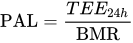
The physical activity level is defined for a non-pregnant, non-lactating adult as that person's total energy expenditure (TEE) in a 24-hour period, divided by his or her basal metabolic rate (BMR):
The level of physical activity can also be estimated based on a list of the physical activities a person performs from day to day. Each activity is connected to a number, the physical activity ratio. The physical activity level is then the time-weighted average of the physical activity ratios.
02Examples
The following table shows indicative numbers for the Physical activity level for several lifestyles:
| Lifestyle | Example | PAL |
|---|---|---|
| Extremely inactive | Cerebral palsy patient | <1.40 |
| Sedentary | Office worker getting little or no exercise | 1.40-1.69 |
| Moderately active | Construction worker or person running one hour daily | 1.70-1.99 |
| Vigorously active | Agricultural worker (non mechanized) or person swimming two hours daily | 2.00-2.4 |
| Extremely active | Competitive cyclist | >2.40 |
Sources and credits
This article is adapted from the Wikipedia article “Physical activity level”, written by its contributors and licensed under CC BY-SA 4.0. Fathomly has changed the layout, removed citation markers, navigation and maintenance notices, and adjusted punctuation. This adapted version is shared under the same license. For references, see the original article.
Images, from Wikimedia Commons:
- Soldier running in water.jpg by Cpl. Earnest J. Barnes, Public domain
Fathomly is not affiliated with or endorsed by the Wikimedia Foundation. Spotted a problem? Tell us.