Perturbation function
In mathematical optimization, the perturbation function is any function which relates to primal and dual problems. The name comes from the fact that any such function defines a perturbation of the initial problem. In many cases this takes the form of shifting the constraints.
In some texts the value function is called the perturbation function, and the perturbation function is called the bifunction.
01Definition
Given two dual pairs of separated locally convex spaces 



If there are constraint conditions, these can be built into the function 




02Use in duality
The duality gap is the difference of the right and left hand side of the inequality

where 
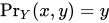
For any choice of perturbation function F weak duality holds. There are a number of conditions which if satisfied imply strong duality. For instance, if F is proper, jointly convex, lower semi-continuous with 


03Examples
Lagrangian
Let 



In particular the weak duality minmax equation can be shown to be

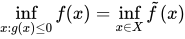
If the primal problem is given by
where 

then the perturbation function is

Thus the connection to Lagrangian duality can be seen, as L can be trivially seen to be

Fenchel duality
Let 





In particular if the primal objective is 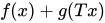

Sources and credits
This article is adapted from the Wikipedia article “Perturbation function”, written by its contributors and licensed under CC BY-SA 4.0. Fathomly has changed the layout, removed citation markers, navigation and maintenance notices, and adjusted punctuation. This adapted version is shared under the same license. For references, see the original article.
Fathomly is not affiliated with or endorsed by the Wikimedia Foundation. Spotted a problem? Tell us.