Perpendicular axis theorem
Mathematical theorem

The perpendicular axis theorem (or plane figure theorem) states that for a planar lamina the moment of inertia about an axis perpendicular to the plane of the lamina is equal to the sum of the moments of inertia about two mutually perpendicular axes in the plane of the lamina, which intersect at the point where the perpendicular axis passes through. This theorem applies only to planar bodies and is valid when the body lies entirely in a single plane.
Define perpendicular axes 


This rule can be applied with the parallel axis theorem and the stretch rule to find polar moments of inertia for a variety of shapes.
If a planar object has rotational symmetry such that 


01Derivation
Working in Cartesian coordinates, the moment of inertia of the planar body about the

On the plane, 
Note that 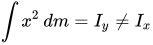


Sources and credits
This article is adapted from the Wikipedia article “Perpendicular axis theorem”, written by its contributors and licensed under CC BY-SA 4.0. Fathomly has changed the layout, removed citation markers, navigation and maintenance notices, and adjusted punctuation. This adapted version is shared under the same license. For references, see the original article.
Images, from Wikimedia Commons:
- Thinplate01.JPG by 老陳, CC BY-SA 3.0
Fathomly is not affiliated with or endorsed by the Wikimedia Foundation. Spotted a problem? Tell us.