Pendulum wave
Type of physics demonstration

A pendulum wave is an elementary physics demonstration and kinetic art comprising a number of uncoupled simple pendulums with monotonically increasing lengths. As the pendulums oscillate, they appear to produce travelling and standing waves, beating, and random motion.
01History
Ernst Mach designed and constructed the first pendulum wave demonstration around 1867 at Charles-Ferdinand University in Prague. In the Czech Republic, the demonstration is called Mach's wave machine. Eric J. Heller at Harvard University suggested the use of the demonstration to simulate quantum revival.
In 2001, two University of Minnesota Morris researchers have derived a continuous function explaining the patterns in the pendulums using an extension to the equation for traveling waves in one dimension, and showed that their cycling arises from aliasing of the underlying continuous function.
In 2020, illusionist Kevin McMahon, incorporated a massive pendulum wave apparatus, supposedly with flaming cannonballs, as a stunt in Britain's Got Talent (series 14) under the stage name Kevin Quantum.

02Design
|
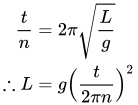
The lengths of the pendulums are set such that in a given time t, the first pendulum completes n oscillations, and each subsequent one completes one more oscillation than the previous. As all pendulums are started together, their relative phases change continuously, but after time t, they come back in sync and the sequence repeats. For small perturbations, the period of a pendulum is given by where L is the length of the pendulum and g is the standard acceleration due to gravity. As t/n is the period of a pendulum completing n oscillations in t, A common choice of t is 60 seconds. Thus, for g ≈ 9.8 ms−2, |
Parameters of the |


Sources and credits
This article is adapted from the Wikipedia article “Pendulum wave”, written by its contributors and licensed under CC BY-SA 4.0. Fathomly has changed the layout, removed citation markers, navigation and maintenance notices, and adjusted punctuation. This adapted version is shared under the same license. For references, see the original article.
Images, from Wikimedia Commons:
- Pendulum wave animation.svg by Cmglee, CC BY-SA 4.0
- Ivo Schoofs, Large Pendulum Wave, 2017 (32259504263).jpg by art_inthecity from Montréal, CA, CC BY 2.0
Fathomly is not affiliated with or endorsed by the Wikimedia Foundation. Spotted a problem? Tell us.
