Partial specific volume
The partial specific volume 
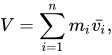
where 

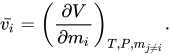
The PSV is usually measured in milliLiters (mL) per gram (g), proteins > 30 kDa can often be assumed to have a partial specific volume of 0.708 mL/g, though this estimate varies depending on the amount of volume accessible by solvent or bound molecules. Experimental determination is possible by measuring the natural frequency of a U-shaped tube filled successively with air, buffer and protein solution.
01Properties
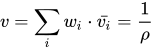
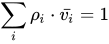
The weighted sum of partial specific volumes of a mixture or solution is an inverse of density of the mixture namely the specific volume of the mixture.
Sources and credits
This article is adapted from the Wikipedia article “Partial specific volume”, written by its contributors and licensed under CC BY-SA 4.0. Fathomly has changed the layout, removed citation markers, navigation and maintenance notices, and adjusted punctuation. This adapted version is shared under the same license. For references, see the original article.
Fathomly is not affiliated with or endorsed by the Wikimedia Foundation. Spotted a problem? Tell us.