Pseudorandom binary sequence
Seemingly random, difficult to predict bit stream created by a deterministic algorithm
A pseudorandom binary sequence (PRBS), pseudorandom binary code or pseudorandom bitstream is a binary sequence that, while generated with a deterministic algorithm, is difficult to predict and exhibits statistical behavior similar to a truly random sequence. PRBS generators are used in telecommunication, such as in analog-to-information conversion, but also in encryption, simulation, correlation technique and time-of-flight spectroscopy. The most common example is the maximum length sequence generated by a (maximal) linear feedback shift register (LFSR). Other examples are Gold sequences (used in CDMA and GPS), Kasami sequences and JPL sequences, all based on LFSRs.
In telecommunications, pseudorandom binary sequences are known as pseudorandom noise codes (PN or PRN codes) due to their application as pseudorandom noise.
01Details
A binary sequence (BS) is a sequence 

for
.
A BS consists of 

A BS is a pseudorandom binary sequence (PRBS) if its autocorrelation function, given by
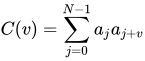
has only two values:
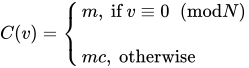
where

is called the duty cycle of the PRBS, similar to the duty cycle of a continuous time signal. For a maximum length sequence, where 
A PRBS is 'pseudorandom', because, although it is in fact deterministic, it seems to be random in a sense that the value of an 
A PRBS can be stretched to infinity by repeating it after
02Practical implementation
Pseudorandom binary sequences can be generated using linear-feedback shift registers.
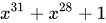
Some common sequence generating monic polynomials are
- PRBS7 =

- PRBS9 =

- PRBS11 =

- PRBS13 =

- PRBS15 =
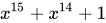
- PRBS20 =

- PRBS23 =
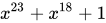
- PRBS31 =
An example of generating a "PRBS-7" sequence can be expressed in C as
#include <stdio.h> #include <stdint.h> #include <stdlib.h> int main(int argc, char* argv[]) { uint8_t start = 0x02; uint8_t a = start; int i; for (i = 1;; i++) { int newbit = (((a >> 6) ^ (a >> 5)) & 1); a = ((a << 1) | newbit) & 0x7f; printf("%x\n", a); if (a == start) { printf("repetition period is %d\n", i); break; } } }In this particular case, "PRBS-7" has a repetition period of 127 values.
03Notation
The PRBSk or PRBS-k notation (such as "PRBS7" or "PRBS-7") gives an indication of the size of the sequence. 
Those 7 words are all of the 
Sources and credits
This article is adapted from the Wikipedia article “Pseudorandom binary sequence”, written by its contributors and licensed under CC BY-SA 4.0. Fathomly has changed the layout, removed citation markers, navigation and maintenance notices, and adjusted punctuation. This adapted version is shared under the same license. For references, see the original article.
Fathomly is not affiliated with or endorsed by the Wikimedia Foundation. Spotted a problem? Tell us.