P-adic exponential function
Mathematical function
In mathematics, particularly p-adic analysis, the p-adic exponential function is a p-adic analogue of the usual exponential function on the complex numbers. As in the complex case, it has an inverse function, named the p-adic logarithm.
01Definition
The usual exponential function on 
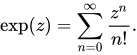
Entirely analogously, one defines the exponential function on 

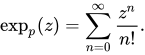
However, unlike exp which converges on all of 
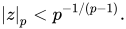
This is because p-adic series converge if and only if the summands tend to zero, and since the 
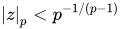


Although the p-adic exponential is sometimes denoted 


02p-adic logarithm function
The power series
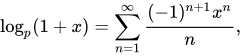
converges for 


p (the set of nonzero elements of 

p can be written as 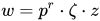



p is sometimes called the Iwasawa logarithm to emphasize the choice of
p for each choice of 
03Properties
If 

Similarly if
For 

The roots of the Iwasawa logarithm 
Note that there is no analogue in 
Another major difference to the situation in 
Sources and credits
This article is adapted from the Wikipedia article “P-adic exponential function”, written by its contributors and licensed under CC BY-SA 4.0. Fathomly has changed the layout, removed citation markers, navigation and maintenance notices, and adjusted punctuation. This adapted version is shared under the same license. For references, see the original article.
Fathomly is not affiliated with or endorsed by the Wikimedia Foundation. Spotted a problem? Tell us.