Omega meson
Subatomic particle
The omega meson (ω) is a flavourless meson formed from a superposition of an up quark, antiquark and a down quark, antiquark pair. It is part of the vector meson nonet and mediates the nuclear force along with pions and rho mesons.
01Properties
The most common decay mode for the ω meson is π+
π0
π−
at 89.2%±0.7%, followed by π0
γ at 8.34%±0.26%.
| Particle name | Particle symbol |
Antiparticle symbol |
Quark content |
Rest mass (MeV/c2) | IG | JP C | S | C | B' | Mean lifetime (s) | Commonly decays to (>5% of decays) |
|---|---|---|---|---|---|---|---|---|---|---|---|
| Omega meson | ω(782) | Self |  |
782.66 ± 0.13 | 0− | 1−− | 0 | 0 | 0 | (7.58±0.11)×10−23 s | π+ +π0 +π− or π0 +γ |
The quark composition of the ω meson can be thought of as a mix between uu, dd and ss states, but it is very nearly a pure symmetric uu, dd state. This can be shown by deconstructing the wave function of the ω into its component parts. We see that the ω and ϕ mesons are mixtures of the SU(3) wave functions as follows.
,
,
where
is the nonet mixing angle,
and
.
The mixing angle at which the components decouple completely can be calculated to be 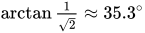
Sources and credits
This article is adapted from the Wikipedia article “Omega meson”, written by its contributors and licensed under CC BY-SA 4.0. Fathomly has changed the layout, removed citation markers, navigation and maintenance notices, and adjusted punctuation. This adapted version is shared under the same license. For references, see the original article.
Fathomly is not affiliated with or endorsed by the Wikimedia Foundation. Spotted a problem? Tell us.


