Octagonal number
Number of points in an octagonal arrangement

In mathematics, an octagonal number is a figurate number. The nth octagonal number on is the number of dots in a pattern of dots consisting of the outlines of regular octagons with sides up to n dots, when the octagons are overlaid so that they share one vertex. The octagonal number for n is given by the formula 3n2 − 2n, with n > 0. The first few octagonal numbers are
- 1, 8, 21, 40, 65, 96, 133, 176, 225, 280, 341, 408, 481, 560, 645, 736, 833, 936 (sequence A000567 in the OEIS)
The octagonal number for n can also be calculated by adding the square of n to twice the (n − 1)th pronic number.
Octagonal numbers consistently alternate parity.
Octagonal numbers are occasionally referred to as "star numbers", though that term is more commonly used to refer to centered dodecagonal numbers.
01Applications in combinatorics
The 


- [1,1,1,1,1,1,1], [1,1,1,1,1,2], [1,1,1,1,3], [1,1,1,2,2], [1,1,2,3], [1,2,2,2], [1,3,3] and [2,2,3].
02Sum of reciprocals
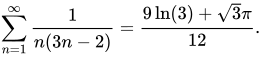
A formula for the sum of the reciprocals of the octagonal numbers is given by
03Test for octagonal numbers
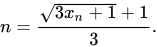
Solving the formula for the n-th octagonal number, 
Sources and credits
This article is adapted from the Wikipedia article “Octagonal number”, written by its contributors and licensed under CC BY-SA 4.0. Fathomly has changed the layout, removed citation markers, navigation and maintenance notices, and adjusted punctuation. This adapted version is shared under the same license. For references, see the original article.
Images, from Wikimedia Commons:
- OctagonalNumbers.svg by Nwbeeson, CC0
Fathomly is not affiliated with or endorsed by the Wikimedia Foundation. Spotted a problem? Tell us.
