Reference articles on history, science, culture and more
Encyclopedia

Normal cone (algebraic geometry)

Scheme in algebraic geometry

In algebraic geometry, the normal cone of a subscheme of a scheme is a scheme analogous to the normal bundle or tubular neighborhood in differential geometry.

01Definition

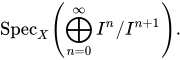
The normal cone CXY or C_{X/Y} of an embedding i: X Y, defined by some sheaf of ideals I, is defined as the relative Spec \operatorname {Spec} _{X}\left(\bigoplus _{n=0}^{\infty }I^{n}/I^{n+1}\right).

When the embedding i is regular the normal cone is the normal bundle, the vector bundle on X corresponding to the dual of the sheaf I/I2.

If X is a point, then the normal cone and the normal bundle to it are also called the tangent cone and the tangent space (Zariski tangent space) to the point. When Y = Spec R is affine, the definition means that the normal cone to X = Spec R/I is the Spec of the associated graded ring of R with respect to I.

If Y is the product X × X and the embedding i is the diagonal embedding, then the normal bundle to X in Y is the tangent bundle to X.

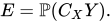
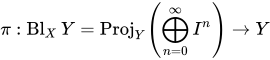
The normal cone (or rather its projective cousin) appears as a result of blow-up. Precisely, let \pi :\operatorname {Bl} _{X}Y=\operatorname {Proj} _{Y}\left(\bigoplus _{n=0}^{\infty }I^{n}\right)\to Y be the blow-up of Y along X. Then, by definition, the exceptional divisor is the pre-image E=\pi ^{-1}(X); which is the projective cone of {\textstyle \bigoplus _{0}^{\infty }I^{n}\otimes _{{\mathcal {O}}_{Y}}{\mathcal {O}}_{X}=\bigoplus _{0}^{\infty }I^{n}/I^{n+1}. Thus, E=\mathbb {P} (C_{X}Y).
The global sections of the normal bundle classify embedded infinitesimal deformations of Y in X; there is a natural bijection between the set of closed subschemes of Y ×k D, flat over the ring D of dual numbers and having X as the special fiber, and H0(X, NX Y).

02Properties

Compositions of regular embeddings

If i:X\hookrightarrow Y,\,j:Y\hookrightarrow Z are regular embeddings, then j\circ i is a regular embedding and there is a natural exact sequence of vector bundles on X: 0\to N_{X/Y}\to N_{X/Z}\to i^{*}N_{Y/Z}\to 0.

If Y_{i}\hookrightarrow X are regular embeddings of codimensions c_{i} and if {\textstyle W:=\bigcap _{i}Y_{i}\hookrightarrow X is a regular embedding of codimension \sum c_{i} then N_{W/X}=\bigoplus _{i}N_{Y_{i}/X}|_{W}. In particular, if X\to S is a smooth morphism, then the normal bundle to the diagonal embedding \Delta :X\hookrightarrow X\times _{S}\cdots \times _{S}X (r-fold) is the direct sum of r − 1 copies of the relative tangent bundle T_{X/S}.

If X\hookrightarrow Y is a closed immersion and if Y'\to Y is a flat morphism such that X'=X\times _{Y}Y', then C_{X'/Y'}=C_{X/Y}\times _{X}X'.

If X\to S is a smooth morphism and X\hookrightarrow Y is a regular embedding, then there is a natural exact sequence of vector bundles on X: 0\to T_{X/S}\to T_{Y/S}|_{X}\to N_{X/Y}\to 0 (which is a special case of an exact sequence for cotangent sheaves).

Cartesian square

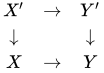
For a Cartesian square of schemes {\begin{matrix}X'&\to &Y'\\\downarrow &&\downarrow \\X&\to &Y\end{matrix}} with f:X'\to X the vertical map, there is a closed embedding C_{X'/Y'}\hookrightarrow f^{*}C_{X/Y} of normal cones.
Dimension of components

Let X be a scheme of finite type over a field and W\subset X a closed subscheme. If X is of pure dimension r; i.e., every irreducible component has dimension r, then C_{W/X} is also of pure dimension r. (This can be seen as a consequence of #Deformation to the normal cone.) This property is a key to an application in intersection theory: given a pair of closed subschemes V,X in some ambient space, while the scheme-theoretic intersection V\cap X has irreducible components of various dimensions, depending delicately on the positions of V,X, the normal cone to V\cap X is of pure dimension.

03Examples

Let D\hookrightarrow X be an effective Cartier divisor. Then the normal bundle to it (or equivalently the normal cone to it) is N_{D/X}={\mathcal {O}}_{D}(D):={\mathcal {O}}_{X}(D)|_{D}.

Non-regular embedding

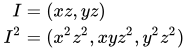
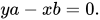
Consider the non-regular embedding X={\text{Spec}}\left({\frac {\mathbb {C} [x,y,z]}{(xz,yz)}}\right)\to \mathbb {A} ^{3} then, we can compute the normal cone by first observing {\begin{aligned}I&=(xz,yz)\\I^{2}&=(x^{2}z^{2},xyz^{2},y^{2}z^{2})\\\end{aligned}} If we make the auxiliary variables a=xz and b=yz we get the relation ya-xb=0. We can use this to give a presentation of the normal cone as the relative spectrum C_{X}\mathbb {A} ^{3}={\text{Spec}}_{X}\left({\frac {{\mathcal {O}}_{X}[a,b]}{(ya-xb)}}\right) Since \mathbb {A} ^{3} is affine, we can just write out the relative spectrum as the affine scheme C_{X}\mathbb {A} ^{3}={\text{Spec}}\left({\frac {\mathbb {C} [x,y,z][a,b]}{(xz,yz,ya-xb)}}\right) giving us the normal cone.

Geometry of this normal cone

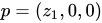
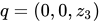
The normal cone's geometry can be further explored by looking at the fibers for various closed points of X. Note that geometrically X is the union of the xy-plane H with the z-axis L, X=H\cup L so the points of interest are smooth points on the plane, smooth points on the axis, and the point on their intersection. Any smooth point on the plane is given by a map {\begin{matrix}x\mapsto z_{1}&y\mapsto z_{2}&z\mapsto 0\end{matrix}} for z_{1},z_{2}\in \mathbb {C} and either z_{1}\neq 0 or z_{2}\neq 0. Since it is arbitrary which point we take, for convenience let us assume z_{1}\neq 0,z_{2}=0. Hence the fiber of C_{X}\mathbb {A} ^{3} at the point p=(z_{1},0,0) is isomorphic to C_{X}\mathbb {A} ^{3}|_{p}\cong {\frac {\mathbb {C} [a,b]}{(z_{1}b)}}\cong \mathbb {C} [a] giving the normal cone as a one dimensional line, as expected. For a point q on the axis, this is given by a map {\begin{matrix}x\mapsto 0&y\mapsto 0&z\mapsto z_{3}\end{matrix}} hence the fiber at the point q=(0,0,z_{3}) is C_{X}\mathbb {A} ^{3}|_{q}\cong {\frac {\mathbb {C} [a,b]}{(0)}}\cong \mathbb {C} [a,b] which gives a plane. At the origin r=(0,0,0), the normal cone over that point is again isomorphic to \mathbb {C} [a,b].

Nodal cubic

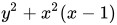
For the nodal cubic curve Y given by the polynomial y^{2}+x^{2}(x-1) over \mathbb {C}, and X the point at the node, the cone has the isomorphism C_{X/Y}\cong {\text{Spec}}\left(\mathbb {C} [x,y]/\left(y^{2}-x^{2}\right)\right) showing the normal cone has more components than the scheme it lies over.
04Deformation to the normal cone

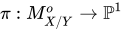
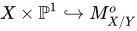
Suppose i:X\to Y is an embedding. This can be deformed to the embedding of X inside the normal cone C_{X/Y} (as the zero section) in the following sense: there is a flat family \pi :M_{X/Y}^{o}\to \mathbb {P} ^{1} with generic fiber Y and special fiber C_{X/Y} such that there exists a family of closed embeddings X\times \mathbb {P} ^{1}\hookrightarrow M_{X/Y}^{o} over \mathbb {P} ^{1} such that

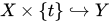
  1. Over any point t\in \mathbb {P} ^{1}-\{0\} the associated embeddings are an embedding X\times \{t\}\hookrightarrow Y
  2. The fiber over 0\in \mathbb {P} ^{1} is the embedding of X\hookrightarrow C_{X/Y} given by the zero section.

This construction defines a tool analogous to differential topology where non-transverse intersections are performed in a tubular neighborhood of the intersection. Now, the intersection of X with a cycle Z in Y can be given as the pushforward of an intersection of X with the pullback of Z in C_{X/Y}.

Construction

One application of this is to define intersection products in the Chow ring. Suppose that X and V are closed subschemes of Y with intersection W, and we wish to define the intersection product of X and V in the Chow ring of Y. Deformation to the normal cone in this case means that we replace the embeddings of X and W in Y and V by their normal cones CY(X) and CW(V), so that we want to find the product of X and CWV in CXY. This can be much easier: for example, if X is regularly embedded in Y then its normal cone is a vector bundle, so we are reduced to the problem of finding the intersection product of a subscheme CWV of a vector bundle CXY with the zero section X. However this intersection product is just given by applying the Gysin isomorphism to CWV.

Concretely, the deformation to the normal cone can be constructed by means of blowup. Precisely, let \pi :M\to Y\times \mathbb {P} ^{1} be the blow-up of Y\times \mathbb {P} ^{1} along X\times 0. The exceptional divisor is {\overline {C_{X}Y}}=\mathbb {P} (C_{X}Y\oplus 1), the projective completion of the normal cone; for the notation used here see Cone (algebraic geometry) § Properties. The normal cone C_{X}Y is an open subscheme of {\overline {C_{X}Y}} and X is embedded as a zero-section into C_{X}Y.

Now, we note:

  1. The map \rho :M\to \mathbb {P} ^{1}, the \pi followed by projection, is flat.
  2. There is an induced closed embedding {\widetilde {i}}:X\times \mathbb {P} ^{1}\hookrightarrow M that is a morphism over \mathbb {P} ^{1}.
  3. M is trivial away from zero; i.e., \rho ^{-1}(\mathbb {P} ^{1}-0)=Y\times (\mathbb {P} ^{1}-0) and {\widetilde {i}} restricts to the trivial embedding X\times (\mathbb {P} ^{1}-0)\hookrightarrow Y\times (\mathbb {P} ^{1}-0).
  4. \rho ^{-1}(0) as the divisor is the sum {\overline {C_{X}Y}}+{\widetilde {Y}} where {\widetilde {Y}} is the blow-up of Y along X and is viewed as an effective Cartier divisor.
  5. As divisors {\overline {C_{X}Y}} and {\widetilde {Y}} intersect at \mathbb {P} (C), where \mathbb {P} (C) sits at infinity in {\overline {C_{X}Y}}.

Item 1 is clear (check torsion-free-ness). In general, given X\subset Y, we have \operatorname {Bl} _{V}X\subset \operatorname {Bl} _{V}Y. Since X\times 0 is already an effective Cartier divisor on X\times \mathbb {P} ^{1}, we get X\times \mathbb {P} ^{1}=\operatorname {Bl} _{X\times 0}X\times \mathbb {P} ^{1}\hookrightarrow M, yielding {\widetilde {i}}. Item 3 follows from the fact the blowdown map π is an isomorphism away from the center X\times 0. The last two items are seen from explicit local computation. Q.E.D.

Now, the last item in the previous paragraph implies that the image of X\times 0 in M does not intersect {\widetilde {Y}}. Thus, one gets the deformation of i to the zero-section embedding of X into the normal cone.

05Intrinsic normal cone

Intrinsic normal bundle

Let X be a Deligne-Mumford stack locally of finite type over a field k. If {\textbf {L}}_{X} denotes the cotangent complex of X relative to k, then the intrinsic normal bundle to X is the quotient stack {\mathfrak {N}}_{X}:=h^{1}/h^{0}({\textbf {L}}_{X,{\text{fppf}}}^{\vee }) which is the stack of fppf {\textbf {L}}_{X}^{\vee ,0}-torsors on {\textbf {L}}_{X}^{\vee ,1}. A concrete interpretation of this stack quotient can be given by looking at its behavior locally in the étale topos of the stack X.

Properties of intrinsic normal bundle

More concretely, suppose there is an étale morphism U\to X from an affine finite-type k-scheme U together with a locally closed immersion f:U\to M into a smooth affine finite-type k-scheme M. Then one can show {\mathfrak {N}}_{X}|_{U}=[N_{U/M}/f^{*}T_{M}] meaning we can understand the intrinsic normal bundle as a stacky incarnation for the failure of the normal sequence {\mathcal {T}}_{U}\to {\mathcal {T}}_{M}|_{U}\to {\mathcal {N}}_{U/M} to be exact on the right hand side. Moreover, for special cases discussed below, we are now considering the quotient as a continuation of the previous sequence as a triangle in some triangulated category. This is because the local stack quotient [N_{U/M}/f^{*}T_{M}] can be interpreted as B{\mathcal {T}}_{U}={\mathcal {T}}_{U}[+1] in certain cases.

Normal cone

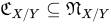
The intrinsic normal cone to X, denoted as {\mathfrak {C}}_{X}, is then defined by replacing the normal bundle N_{U/M} with the normal cone C_{U/M}; i.e., {\mathfrak {C}}_{X}|_{U}=[C_{U/M}/f^{*}T_{M}].

Example: One has that X is a local complete intersection if and only if {\mathfrak {C}}_{X}={\mathfrak {N}}_{X}. In particular, if X is smooth, then {\mathfrak {C}}_{X}={\mathfrak {N}}_{X}=BT_{X} is the classifying stack of the tangent bundle T_{X}, which is a commutative group scheme over X.

More generally, let X\to Y is a Deligne-Mumford Type (DM-type) morphism of Artin Stacks which is locally of finite type. Then {\mathfrak {C}}_{X/Y}\subseteq {\mathfrak {N}}_{X/Y} is characterised as the closed substack such that, for any étale map U\to X for which U\to X\to Y factors through some smooth map M\to Y (e.g., \mathbb {A} _{Y}^{n}\to Y), the pullback is: {\mathfrak {C}}_{X/Y}|_{U}=[C_{U/M}/T_{M/Y}|_{U}].

Watch videos about Normal cone (algebraic geometry)Explainers and documentaries on YouTube (opens in a new tab)

Sources and credits

This article is adapted from the Wikipedia article Normal cone (algebraic geometry), written by its contributors and licensed under CC BY-SA 4.0. Fathomly has changed the layout, removed citation markers, navigation and maintenance notices, and adjusted punctuation. This adapted version is shared under the same license. For references, see the original article.

Fathomly is not affiliated with or endorsed by the Wikimedia Foundation. Spotted a problem? Tell us.

Continue exploring

Related topics