Reference articles on history, science, culture and more
Encyclopedia

Nonlocal operator

Class of operator mapping

In mathematics, a nonlocal operator is a mapping that maps a space of functions on a topological space to another space of functions on some domain in such a way that the value of the function output at a given point cannot be determined solely from the values of the input function in an arbitrary neighbourhood of any point. An example of a nonlocal operator is the Fourier transform.

01Formal definition

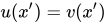
Let X be a topological space, Y a set, F(X) a function space containing functions with domain X, and G(Y) a function space containing functions with domain Y. Two functions u and v in F(X) are called equivalent at x\in X if there exists a neighbourhood N of x such that u(x')=v(x') for all x'\in N. An operator A:F(X)\to G(Y) is said to be local if for every y\in Y there exists an x\in X such that Au(y)=Av(y) for all functions u and v in F(X) which are equivalent at x. A nonlocal operator is an operator which is not local.

For a local operator it is possible (in principle) to compute the value Au(y) using only knowledge of the values of u in an arbitrarily small neighbourhood of a point x. For a nonlocal operator this is not possible.

02Examples

Differential operators are examples of local operators. A large class of (linear) nonlocal operators is given by the integral transforms, such as the Fourier transform and the Laplace transform. For an integral transform of the form
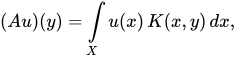
(Au)(y)=\int \limits _{X}u(x)\,K(x,y)\,dx,

where K is some kernel function, it is necessary to know the values of u almost everywhere on the support of K(\cdot ,y) in order to compute the value of Au at y.

An example of a singular integral operator is the fractional Laplacian
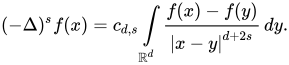
(-\Delta )^{s}f(x)=c_{d,s}\int \limits _{\mathbb {R} ^{d}}{\frac {f(x)-f(y)}{|x-y|^{d+2s}}}\,dy.

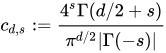
The prefactor c_{d,s}:={\frac {4^{s}\Gamma (d/2+s)}{\pi ^{d/2}|\Gamma (-s)|}} involves the Gamma function and serves as a normalizing factor. The fractional Laplacian plays a role in, for example, the study of nonlocal minimal surfaces.

03Applications

Some examples of applications of nonlocal operators are:

Watch videos about Nonlocal operatorExplainers and documentaries on YouTube (opens in a new tab)

Sources and credits

This article is adapted from the Wikipedia article Nonlocal operator, written by its contributors and licensed under CC BY-SA 4.0. Fathomly has changed the layout, removed citation markers, navigation and maintenance notices, and adjusted punctuation. This adapted version is shared under the same license. For references, see the original article.

Fathomly is not affiliated with or endorsed by the Wikimedia Foundation. Spotted a problem? Tell us.

Continue exploring

Related topics

Fractional calculus

Fractional calculus is a branch of mathematical analysis that studies the several different possibilities of defining real number powers or complex number powers of the differentiation operator D {\displaystyle D} D f = d d x f ( x ) , {\displaystyle Df(x)={\frac {d}{dx}}f(x)\,,} and of the integration operator J {\displaystyle J} J f ( x ) = ∫ 0 x f ( s ) d s , {\displaystyle Jf(x)=\int _{0}^{x}f(s)\,ds\,,} and developing a calculus for such operators generalizing the classical one. In this context, the term powers refers to iterative application of a linear operator D {\displaystyle D} to a function f {\displaystyle f} , that is, repeatedly composing D {\displaystyle D} with itself, as in D n ( f ) = ( D ∘ D ∘ D ∘ ⋯ ∘ D ⏟ n ) ( f ) = D ( D ( D ( ⋯ D ⏟ n ( f ) ⋯ ) ) ) .

Linear map

In mathematics, and more specifically in linear algebra, a linear map, linear mapping, or linear operator is a particular kind of function between vector spaces, which respects the basic operations of vector addition and scalar multiplication. A standard example of a linear map is an m × n {\displaystyle m\times n} matrix, which takes vectors in n {\displaystyle n} -dimensions into vectors in m {\displaystyle m} -dimensions in a way that is compatible with addition of vectors, and multiplication of vectors by scalars.

Nonlocal Lagrangian

In field theory, a nonlocal Lagrangian is a Lagrangian, a type of functional L [ ϕ ] {\displaystyle {\mathcal {L}}[\phi (x)]} containing terms that are nonlocal in the fields ϕ ( x ) {\displaystyle \phi (x)} , i.e. not polynomials or functions of the fields or their derivatives evaluated at a single point in the space of dynamical parameters (e.g.