Noether normalization lemma
Result of commutative algebra
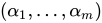
In mathematics, the Noether normalization lemma (sometimes referred to as a theorem rather than a lemma) is a result of commutative algebra, introduced by Emmy Noether in 1926. It states that for any field 


![S=k[y_{1},y_{2},\ldots ,y_{d}]](https://wikimedia.org/api/rest_v1/media/math/render/svg/a24614a283d3700190d7dad9b927e8a3d91e0b05)

The theorem has a geometric interpretation. Suppose A is the coordinate ring of an affine variety X, and consider S as the coordinate ring of a d-dimensional affine space 


More generally, in the language of schemes, the theorem can equivalently be stated as: every affine k-scheme (of finite type) X is finite over an affine n-dimensional space. The theorem can be refined to include a chain of ideals of R (equivalently, closed subsets of X) that are finite over the affine coordinate subspaces of the corresponding dimensions.
The Noether normalization lemma yields Zariski's lemma as a corollary. In turn, Zariski's lemma can be used to give a straightforward proof of Hilbert's Nullstellensatz, one of the most fundamental results of classical algebraic geometry. Noether normalization is also an important tool in establishing the notion of Krull dimension for k-algebras.
01Statement and proof
Theorem. (Noether Normalization Lemma) Let k be a field and ![A=k[y_{1}',...,y_{m}']](https://wikimedia.org/api/rest_v1/media/math/render/svg/841149e2fdd4a1960f827fd472c9e40fdcd6dd40)


![k[y_{1},\ldots ,y_{d}]](https://wikimedia.org/api/rest_v1/media/math/render/svg/72e60841c10b723419d13959596cdd093410c9a5)
The following proof is due to Nagata and appears in Mumford's Red Book. A second, more geometric proof is given on page 176 of the same text.
Proof: We shall induct on m. Case 


![A\cong k[y]/I](https://wikimedia.org/api/rest_v1/media/math/render/svg/e95ffdd9f03773ec337c1bc22f584f07f8ad3a39)
![I\subset k[y]](https://wikimedia.org/api/rest_v1/media/math/render/svg/010cc27d779cc4966e10f7fbee23d7bc903ca858)
![k[y]](https://wikimedia.org/api/rest_v1/media/math/render/svg/621cff7d639e9f8d50516c7f404e6378e6ab6fe6)







![k[y_{1},...,y_{d}]](https://wikimedia.org/api/rest_v1/media/math/render/svg/63ec8840d21a6f82be8ce1e0cb44581b3422c903)
To prove the claim, we assume by hypothesis that the
.
Given an integer r which is determined later, set

and, for simplification of notation, write

Then the preceding reads:

Now, if 


.
Whenever the above exponent agrees with the highest 




![S=k[z_{2},...,z_{m}]](https://wikimedia.org/api/rest_v1/media/math/render/svg/b4e1b4de03c726ce6224d1e3c01fbd214774f346)

![A=S[y_{1}']](https://wikimedia.org/api/rest_v1/media/math/render/svg/e1ad69a594225fd95fda1b7f20d6e97a506f5fdf)
Moreover, if A is an integral domain, then d is the transcendence degree of its field of fractions. Indeed, A and the polynomial ring ![S=k[y_{1},...,y_{d}]](https://wikimedia.org/api/rest_v1/media/math/render/svg/6a9385c6c0da3f521cf2565fcee6305f6c11ec9b)




![T=k[u,z_{2},\dots ,z_{d}]](https://wikimedia.org/api/rest_v1/media/math/render/svg/1588298f931f4b643a4a767f3d07d7f7cc2ae30c)






02Refinement
The following refinement appears in Eisenbud's book, which builds on Nagata's idea:
Theorem, Let A be a finitely generated algebra over a field k, and 

- A is a finitely generated module over the polynomial subring S = k[y1, ..., yd].
.
- If the
's are homogeneous, then yi's may be taken to be homogeneous.
Moreover, if k is an infinite field, then any sufficiently general choice of yI's has Property 1 above ("sufficiently general" is made precise in the proof).
Geometrically speaking, the last part of the theorem says that for 


Corollary, Let A be an integral domain that is a finitely generated algebra over a field. If 
.
In particular, the Krull dimension of the localization of A at any maximal ideal is dim A.
Corollary, Let 

(the special case of Nagata's altitude formula).
03Illustrative application: generic freeness
A typical nontrivial application of the normalization lemma is the generic freeness theorem: Let 


![B[g^{-1}]](https://wikimedia.org/api/rest_v1/media/math/render/svg/5251fbeb5c17b23b4629d58e3b84487f2eb5fede)
![A[g^{-1}]](https://wikimedia.org/api/rest_v1/media/math/render/svg/880d7048e9dce20d56a9c98f4a26542b2eeca8b9)
To prove this, let 


![F[x_{1},\dots ,x_{d}]](https://wikimedia.org/api/rest_v1/media/math/render/svg/2d4c927da1c15018caedb2315b802bc33d21468e)

![A':=A[x_{1},\dots ,x_{d}]\to B.](https://wikimedia.org/api/rest_v1/media/math/render/svg/e5e588efd84b172af453e4b1e002553cfbc39ca6)
Now 



![A'[g^{-1}]](https://wikimedia.org/api/rest_v1/media/math/render/svg/0af8b384fc78b71420b7a60c9e6ecf34df867f74)

![B[g^{-1}],A[g^{-1}]](https://wikimedia.org/api/rest_v1/media/math/render/svg/017cc1ac754d6dada0a255840fe26ae87e89bccb)
![A':=A[x_{1},\dots ,x_{d}]](https://wikimedia.org/api/rest_v1/media/math/render/svg/f325bd44e6713628db6124bcfa3e1b4b24439fe3)




![A'/{\mathfrak {p}}_{i}[g_{i}^{-1}]](https://wikimedia.org/api/rest_v1/media/math/render/svg/e1a8636f0a5b28246fe843e2f47c02e9b0e1bfd6)
![A[g_{i}^{-1}]](https://wikimedia.org/api/rest_v1/media/math/render/svg/cf2a9c4268c5652830eac27f75f456022ab433b8)

Sources and credits
This article is adapted from the Wikipedia article “Noether normalization lemma”, written by its contributors and licensed under CC BY-SA 4.0. Fathomly has changed the layout, removed citation markers, navigation and maintenance notices, and adjusted punctuation. This adapted version is shared under the same license. For references, see the original article.
Fathomly is not affiliated with or endorsed by the Wikimedia Foundation. Spotted a problem? Tell us.