Nitrone
Chemical group (>C=N(O)-)

In organic chemistry, a nitrone is a functional group consisting of an N-oxide of an imine. The general structure is R1R2C=N+(−O−)(−R3), where R3 is not a hydrogen. Their primary application is intermediates in chemical synthesis. A nitrone is a 1,3-dipole used in cycloadditions, and a carbonyl mimic.
01Structure
Nitrones, as a tetrasubstituted double bond, admit cis, trans isomerism.


02Generation of nitrones
Typical nitrone sources are hydroxylamine oxidation or condensation with carbonyl compounds. Secondary hydroxylamines oxidize to nitrones in air over a timescale of several weeks, accelerated by cupric salts.
The most general reagent used for the oxidation of hydroxylamines is aqueous mercuric oxide:
However, a hydroxylamine with two α hydrogens may unsaturate on either side. Carbonyl condensation avoids this ambiguity...
...but is inhibited if both ketone substituents are bulky.
In principle, N-alkylation could produce nitrones from oximes, but in practice electrophiles typically perform a mixture of N- and O-attack.
03Reactions
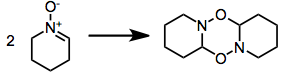
Some nitrones oligomerize:
Syntheses with nitrone precursors obviate the issue with increased temperature, to exaggerate entropic factors; or with a nitrone excess.
Carbonyl mimic
Like many other unsaturated functional groups, nitrones activate the α and β carbons towards reaction. The α carbon is an electrophile and the β carbon a nucleophile; that is, nitrones polarize like carbonyls and nitriles but unlike nitro compounds and vinyl sulfur derivatives.
Nitrones hydrolyze extremely easily to the corresponding carbonyl and N-hydroxylamine.
1,3-dipolar cycloadditions
As 1,3‑dipoles, nitrones perform [3+2] cycloadditions. For example, a dipolarophilic alkene combines to form isoxazolidine:
Other ring-closing reactions are known, including formal [3+3] and [5+2] cycloadditions.
Isomerization
Deoxygenating reagents, light, or heat all catalyze rearrangement to the amide. Acids catalyze rearrangement to the oxime ether.
Reduction
Hydrides add to give hydroxylamines. Reducing Lewis acids (e.g. metals, SO2) deoxygenate to the imine instead.

Sources and credits
This article is adapted from the Wikipedia article “Nitrone”, written by its contributors and licensed under CC BY-SA 4.0. Fathomly has changed the layout, removed citation markers, navigation and maintenance notices, and adjusted punctuation. This adapted version is shared under the same license. For references, see the original article.
Images, from Wikimedia Commons:
- Nitrone-general-structure-2D.png by Ben Mills, Public domain
- NitrMech1.png by DMacks (talk), Public domain
- NitrMech2.png by OrganicReactions, CC BY 3.0
- NitrMech3.png by OrganicReactions, CC BY 3.0
- Nitrone cycloaddition.png by V8rik, Public domain
Fathomly is not affiliated with or endorsed by the Wikimedia Foundation. Spotted a problem? Tell us.

