Neutral vector
In statistics, and specifically in the study of the Dirichlet distribution, a neutral vector of random variables is one that exhibits a particular type of statistical independence amongst its elements. In particular, when elements of the random vector must add up to certain sum, then an element in the vector is neutral with respect to the others if the distribution of the vector created by expressing the remaining elements as proportions of their total is independent of the element that was omitted.
01Definition
A single element 

Formally, consider the vector of random variables

where

The values 


Variable 
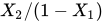

Thus 
In general, variable 


Complete neutrality
A vector for which each element is neutral is completely neutral.
If 
Sources and credits
This article is adapted from the Wikipedia article “Neutral vector”, written by its contributors and licensed under CC BY-SA 4.0. Fathomly has changed the layout, removed citation markers, navigation and maintenance notices, and adjusted punctuation. This adapted version is shared under the same license. For references, see the original article.
Fathomly is not affiliated with or endorsed by the Wikimedia Foundation. Spotted a problem? Tell us.