Reference articles on history, science, culture and more
Encyclopedia

Nerve complex

Complex recording the pattern of intersections between a topological family's sets

In topology, the nerve complex of a set family is an abstract complex that records the pattern of intersections between the sets in the family. It was introduced by Pavel Alexandrov and now has many variants and generalisations, among them the Čech nerve of a cover, which in turn is generalised by hypercoverings. It captures many of the interesting topological properties in an algorithmic or combinatorial way.

01Basic definition

Let I be a set of indices and C be a family of sets (U_{i})_{i\in I}. The nerve of C is a set of finite subsets of the index set I. It contains all finite subsets J\subseteq I such that the intersection of the U_{i} whose subindices are in J is non-empty:

N(C):={\bigg \{}J\subseteq I:\bigcap _{j\in J}U_{j}\neq \varnothing ,J{\text{ finite set}}{\bigg \}}.

In Alexandrov's original definition, the sets (U_{i})_{i\in I} are open subsets of some topological space X.

The set N(C) may contain singletons (elements i\in I such that U_{i} is non-empty), pairs (pairs of elements i,j\in I such that U_{i}\cap U_{j}\neq \emptyset), triplets, and so on. If J\in N(C), then any subset of J is also in N(C), making N(C) an abstract simplicial complex. Hence N(C) is often called the nerve complex of C.

Constructing the nerve of an open good cover containing 3 sets in the plane.

02Examples

  1. Let X be the circle S^{1} and C=\{U_{1},U_{2}\}, where U_{1} is an arc covering the upper half of S^{1} and U_{2} is an arc covering its lower half, with some overlap at both sides (they must overlap at both sides in order to cover all of S^{1}). Then N(C)=\{\{1\},\{2\},\{1,2\}\}, which is an abstract 1-simplex.
  2. Let X be the circle S^{1} and C=\{U_{1},U_{2},U_{3}\}, where each U_{i} is an arc covering one third of S^{1}, with some overlap with the adjacent U_{i}. Then N(C)=\{\{1\},\{2\},\{3\},\{1,2\},\{2,3\},\{3,1\}\}. Note that {1,2,3} is not in N(C) since the common intersection of all three sets is empty; so N(C) is an unfilled triangle.
  3. Let P be a finite set of points in general position (no four points are cocircular) in \mathbb {R} ^{2}, and let C=\{V_{p}\}_{p\in P} be the set of cells of the Voronoi diagram of P. Then the nerve N(C) is the Delaunay triangulation of P. Note that the Voronoi cells are closed sets, so this is a nerve of a closed cover rather than an open one; however, the definition of the nerve applies to arbitrary set families.

03The Čech nerve

Given an open cover C=\{U_{i}:i\in I\} of a topological space X, or more generally a cover in a site, we can consider the pairwise fibre products U_{ij}=U_{i}\times _{X}U_{j}, which in the case of a topological space are precisely the intersections U_{i}\cap U_{j}. The collection of all such intersections can be referred to as C\times _{X}C and the triple intersections as C\times _{X}C\times _{X}C.

By considering the natural maps U_{ij}\to U_{i} and U_{i}\to U_{ii}, we can construct a simplicial object S(C)_{\bullet } defined by S(C)_{n}=C\times _{X}\cdots \times _{X}C, n-fold fibre product. This is the Čech nerve.

By taking connected components we get a simplicial set, which we can realise topologically: |S(\pi _{0}(C))|.

04Nerve theorems

The nerve complex N(C) is a simple combinatorial object. Often, it is much simpler than the underlying topological space (the union of the sets in C). Therefore, a natural question is whether the topology of N(C) is equivalent to the topology of \bigcup C.

In general, this need not be the case. For example, one can cover any n-sphere with two contractible sets U_{1} and U_{2} that have a non-empty intersection, as in example 1 above. In this case, N(C) is an abstract 1-simplex, which is similar to a line but not to a sphere.

However, in some cases N(C) does reflect the topology of X. For example, if a circle is covered by three open arcs, intersecting in pairs as in Example 2 above, then N(C) is a 2-simplex (without its interior) and it is homotopy-equivalent to the original circle.

A nerve theorem (or nerve lemma) is a theorem that gives sufficient conditions on C guaranteeing that N(C) reflects, in some sense, the topology of \bigcup C. A functorial nerve theorem is a nerve theorem that is functorial in an appropriate sense, which is, for example, crucial in topological data analysis.

Leray's nerve theorem

The basic nerve theorem of Jean Leray says that, if any intersection of sets in N(C) is contractible (equivalently: for each finite J\subset I the set \bigcap _{i\in J}U_{i} is either empty or contractible; equivalently: C is a good open cover), then N(C) is homotopy-equivalent to \bigcup C.

Borsuk's nerve theorem

There is a discrete version, which is attributed to Borsuk. Let K1,...,Kn be abstract simplicial complexes, and denote their union by K. Let Ui = ||Ki|| = the geometric realization of Ki, and denote the nerve of {U1, ... , Un } by N.

If, for each nonempty J\subset I, the intersection \bigcap _{i\in J}U_{i} is either empty or contractible, then N is homotopy-equivalent to K.

A stronger theorem was proved by Anders Bjorner. If, for each nonempty J\subset I, the intersection \bigcap _{i\in J}U_{i} is either empty or (k-|J|+1)-connected, then for every jk, the j-th homotopy group of N is isomorphic to the j-th homotopy group of K. In particular, N is k-connected if-and-only-if K is k-connected.

Čech nerve theorem

Another nerve theorem relates to the Čech nerve above: if X is compact and all intersections of sets in C are contractible or empty, then the space |S(\pi _{0}(C))| is homotopy-equivalent to X.

Homological nerve theorem

The following nerve theorem uses the homology groups of intersections of sets in the cover. For each finite J\subset I, denote H_{J,j}:={\tilde {H}}_{j}(\bigcap _{i\in J}U_{i})= the j-th reduced homology group of \bigcap _{i\in J}U_{i}.
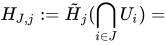
If HJ,j is the trivial group for all J in the k-skeleton of N(C) and for all j in {0, ..., k-dim(J)}, then N(C) is "homology-equivalent" to X in the following sense:

  • {\tilde {H}}_{j}(N(C))\cong {\tilde {H}}_{j}(X) for all j in {0, ..., k};
  • if {\tilde {H}}_{k+1}(N(C))\not \cong 0 then {\tilde {H}}_{k+1}(X)\not \cong 0 .
Watch videos about Nerve complexExplainers and documentaries on YouTube (opens in a new tab)

Sources and credits

This article is adapted from the Wikipedia article Nerve complex, written by its contributors and licensed under CC BY-SA 4.0. Fathomly has changed the layout, removed citation markers, navigation and maintenance notices, and adjusted punctuation. This adapted version is shared under the same license. For references, see the original article.

Images, from Wikimedia Commons:

Fathomly is not affiliated with or endorsed by the Wikimedia Foundation. Spotted a problem? Tell us.




