Neper
Logarithmic unit for ratios of measurements of physical field and power quantities

The neper (symbol: Np) is a logarithmic unit for ratios of measurements of physical field and power quantities, such as gain and loss of electronic signals. The unit's name derives from the name of John Napier, the inventor of logarithms. As is the case for the decibel and bel, the neper is a unit defined in the international standard ISO 80000. It is not part of the International System of Units (SI).
01Definition
Like the decibel, the neper is a unit in a logarithmic scale. While the bel uses the decadic (base-10) logarithm to compute ratios, the neper uses the natural logarithm, based on Euler's number (e ≈ 2.71828). The level of a ratio of two signal amplitudes or root-power quantities, with the unit neper, is given by
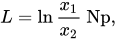
where 

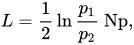
where 

In the International System of Quantities, the neper is defined as 1 Np = 1.

02Units
The neper is defined in terms of ratios of field quantities, also called root-power quantities, (for example, voltage or current amplitudes in electrical circuits, or pressure in acoustics), whereas the decibel was originally defined in terms of power ratios. A power ratio 10 log r dB is equivalent to a field-quantity ratio 20 log r dB, since power in a linear system is proportional to the square (Joule's laws) of the amplitude. Hence the decibel and the neper have a fixed ratio to each other:

and

The (voltage) level ratio is
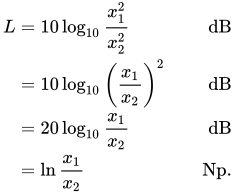
Like the decibel, the neper is a dimensionless unit. The International Telecommunication Union (ITU) recognizes both units. Only the neper is coherent with the SI.
03Applications
The neper is a natural linear unit of relative difference, meaning in nepers (logarithmic units) relative differences add rather than multiply. This property is shared with logarithmic units in other bases, such as the bel.
The derived units decineper (1 dNp = 0.1 neper) and centineper (1 cNp = 0.01 neper) are also used. The centineper for root-power quantities corresponds to a log point or log percentage, see Relative change and difference § Logarithmic scale.
04Works
- Mirifici logarithmorum canonis constructio (in French). Paris: Librairie scientifique Hermann et C.ie. 1825.
Sources and credits
This article is adapted from the Wikipedia article “Neper”, written by its contributors and licensed under CC BY-SA 4.0. Fathomly has changed the layout, removed citation markers, navigation and maintenance notices, and adjusted punctuation. This adapted version is shared under the same license. For references, see the original article.
Images, from Wikimedia Commons:
- John Napier.jpg by Unknown authorUnknown author, Public domain
- Napier, John – Mirifici logarithmorum canonis constructio, 1825 – BEIC 6555650.jpg by John Napier, Public domain
Fathomly is not affiliated with or endorsed by the Wikimedia Foundation. Spotted a problem? Tell us.
