Multiplicative cascade
Fractal distribution of random points
In mathematics, a multiplicative cascade is a fractal/multifractal distribution of points produced via an iterative and multiplicative random process.
01Definition
The plots above are examples of multiplicative cascade multifractals.
To create these distributions there are a few steps to take. Firstly, we must create a lattice of cells which will be our underlying probability density field.
Secondly, an iterative process is followed to create multiple levels of the lattice: at each iteration the cells are split into four equal parts (cells). Each new cell is then assigned a probability randomly from the set 
![p_{i}\in [0,1]](https://wikimedia.org/api/rest_v1/media/math/render/svg/14760da7a7625a3070329a16c4c37033424871fe)
Thirdly, the cells are filled as follows: We take the probability of a cell being occupied as the product of the cell's own pi and those of all its parents (up to level 1). A Monte Carlo rejection scheme is used repeatedly until the desired cell population is obtained, as follows: x and y cell coordinates are chosen randomly, and a random number between 0 and 1 is assigned; the (x, y) cell is then populated depending on whether the assigned number is lesser than (outcome: not populated) or greater or equal to (outcome: populated) the cell's occupation probability.

02Examples
To produce the plots above, the probability density field is filled with 5,000 points in a space of 256 × 256.
An example of the probability density field:
The fractals are generally not scale-invariant and therefore cannot be considered standard fractals. They can however be considered multifractals. The Rényi (generalized) dimensions can be theoretically predicted. It can be shown that as 
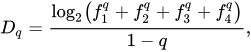
where N is the level of the grid refinement and,

Sources and credits
This article is adapted from the Wikipedia article “Multiplicative cascade”, written by its contributors and licensed under CC BY-SA 4.0. Fathomly has changed the layout, removed citation markers, navigation and maintenance notices, and adjusted punctuation. This adapted version is shared under the same license. For references, see the original article.
Images, from Wikimedia Commons:
- 3fractals2.jpg by User:Csabiu, CC BY-SA 3.0
Fathomly is not affiliated with or endorsed by the Wikimedia Foundation. Spotted a problem? Tell us.
