Multilinear multiplication
In multilinear algebra, applying a map that is the tensor product of linear maps to a tensor is called a multilinear multiplication.
01Abstract definition
Let 









Since the tensor product of linear maps is itself a linear map, and because every tensor admits a tensor rank decomposition, the above expression extends linearly to all tensors. That is, for a general tensor
![{\begin{aligned}&{\mathcal {B}}:=(A_{1}\otimes A_{2}\otimes \cdots \otimes A_{d})({\mathcal {A}})\\[4pt]={}&(A_{1}\otimes A_{2}\otimes \cdots \otimes A_{d})\left(\sum _{i=1}^{r}\mathbf {a} _{i}^{1}\otimes \mathbf {a} _{i}^{2}\otimes \cdots \otimes \mathbf {a} _{i}^{d}\right)\\[5pt]={}&\sum _{i=1}^{r}A_{1}(\mathbf {a} _{i}^{1})\otimes A_{2}(\mathbf {a} _{i}^{2})\otimes \cdots \otimes A_{d}(\mathbf {a} _{i}^{d})\end{aligned}}](https://wikimedia.org/api/rest_v1/media/math/render/svg/578131c96c802126b32a930136da435d8de2f7a3)
where 

It is standard to use the following shorthand notations in the literature for multilinear multiplications:


02Definition in coordinates
In computational multilinear algebra it is conventional to work in coordinates. Assume that an inner product is fixed on 
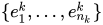

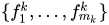


![{\widehat {M}}_{k}=[m_{i,j}^{(k)}]\in F^{m_{k}\times n_{k}}](https://wikimedia.org/api/rest_v1/media/math/render/svg/e40e7abf70005fe2b6848a76da0837bd374cbdba)


![{\widehat {\mathcal {A}}}=[a_{j_{1},j_{2},\ldots ,j_{d}}]\in F^{n_{1}\times n_{2}\times \cdots \times n_{d}}](https://wikimedia.org/api/rest_v1/media/math/render/svg/7a39d34160d0f6db294f09c923100419af8a14df)

where 

![\otimes :(\mathbf {v} ^{(1)},\mathbf {v} ^{(2)},\ldots ,\mathbf {v} ^{(d)})\mapsto [v_{i_{1}}^{(1)}v_{i_{2}}^{(2)}\cdots v_{i_{d}}^{(d)}]_{i_{1},i_{2},\ldots ,i_{d}}](https://wikimedia.org/api/rest_v1/media/math/render/svg/69adb55d53319166d9f59c902210694dc0b5903b)

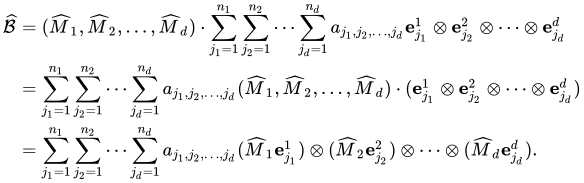
The resulting tensor 

Element-wise definition
From the above expression, an element-wise definition of the multilinear multiplication is obtained. Indeed, since 
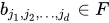
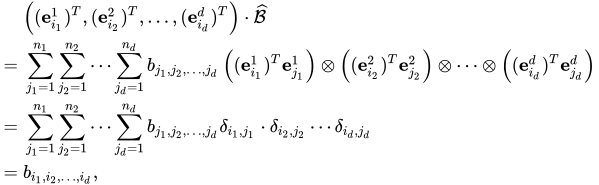
where 
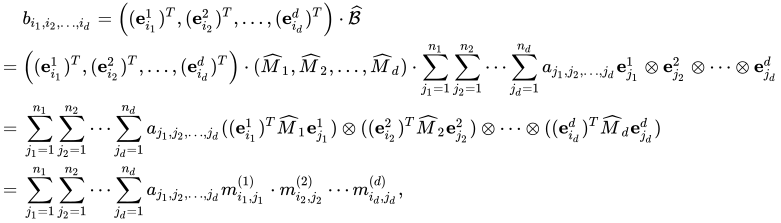
where the 

03Properties
Let
Since a multilinear multiplication is the tensor product of linear maps, we have the following multilinearity property (in the construction of the map):

Multilinear multiplication is a linear map:

It follows from the definition that the composition of two multilinear multiplications is also a multilinear multiplication:

where 

Observe specifically that multilinear multiplications in different factors commute,

if

04Computation
The factor-k multilinear multiplication 

Next, since

there is a bijective map, called the factor-k standard flattening, denoted by 

where 



![[a_{j_{1},\ldots ,j_{k-1},i,j_{k+1},\ldots ,j_{d}}]_{i=1}^{n_{k}}](https://wikimedia.org/api/rest_v1/media/math/render/svg/69ab38a528ff9bc9c3e399924aa3644fb7aae219)
![\mu _{k}:[1,n_{1}]\times \cdots \times [1,n_{k-1}]\times [1,n_{k+1}]\times \cdots \times [1,n_{d}]\to [1,N_{k}].](https://wikimedia.org/api/rest_v1/media/math/render/svg/a3e1d65c6facfa5698a4fcd5230bfa093c2ff272)
In other words, the multilinear multiplication 
05Applications
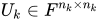
The higher-order singular value decomposition (HOSVD) factorizes a tensor given in coordinates 


Sources and credits
This article is adapted from the Wikipedia article “Multilinear multiplication”, written by its contributors and licensed under CC BY-SA 4.0. Fathomly has changed the layout, removed citation markers, navigation and maintenance notices, and adjusted punctuation. This adapted version is shared under the same license. For references, see the original article.
Fathomly is not affiliated with or endorsed by the Wikimedia Foundation. Spotted a problem? Tell us.