Multidimensional assignment problem
Generalization of linear assignment problem from two to multiple dimensions
The multidimensional assignment problem (MAP) is a fundamental combinatorial optimization problem which was introduced by William Pierskalla. This problem can be seen as a generalization of the linear assignment problem. In words, the problem can be described as follows:
- An instance of the problem has a number of agents (i.e., cardinality parameter) and a number of job characteristics (i.e., dimensionality parameter) such as task, machine, time interval, etc. For example, an agent can be assigned to perform task X, on machine Y, during time interval Z. Any agent can be assigned to perform a job with any combination of unique job characteristics at some cost. These costs may vary based on the assignment of agent to a combination of job characteristics - specific task, machine, time interval, etc. The problem is to minimize the total cost of assigning the agents so that the assignment of agents to each job characteristic is an injective function, or one-to-one function from agents to a given job characteristic.
Alternatively, describing the problem using graph theory:
- The multidimensional assignment problem consists of finding, in a weighted multipartite graph, a matching of a given size, in which the sum of weights of the edges is minimum.
01Formal definition
Various formulations of this problem can be found in the literature. Using cost-functions, the 
- Given
and
, of equal size, together with a cost array or multidimensional weight function
:
, find
permutations
: A →
such that the total cost function:

is minimized.
Problem parameters
The multidimensional assignment problem (MAP) has two key parameters that determine the size of a problem instance:
- The dimensionality parameter
- The cardinality parameter
, where
denotes the number of elements in
Size of cost array
Any problem instance of the MAP with parameters 


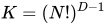
Number of feasible solutions
The feasible region or solution space of the MAP is very large. The number 
02Computational complexity
03Applications
The problem found application in many domains:
Sources and credits
This article is adapted from the Wikipedia article “Multidimensional assignment problem”, written by its contributors and licensed under CC BY-SA 4.0. Fathomly has changed the layout, removed citation markers, navigation and maintenance notices, and adjusted punctuation. This adapted version is shared under the same license. For references, see the original article.
Fathomly is not affiliated with or endorsed by the Wikimedia Foundation. Spotted a problem? Tell us.