Moonlet
Small natural satellite orbiting a planet

A moonlet, minor moon, minor natural satellite, or minor satellite is a particularly small natural satellite orbiting a planet, dwarf planet, or minor planet.
Up until 1995, moonlets were only hypothetical components of Saturn's F-ring structure, but in that year, the Earth passed through Saturn's ring plane. The Hubble Space Telescope and the European Southern Observatory both captured objects orbiting close or near the F-ring. In 2004, Cassini caught an object 4-5 kilometers in diameter on the outer ring of the F-ring and then 5 hours later on the inner F-ring, showing that the object had orbited.
Several different types of small moons have been called moonlets:
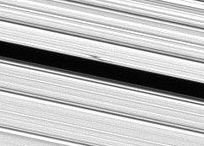
- A belt of objects embedded in a planetary ring, especially around Saturn, such as those in the A Ring, S/2009 S 1 and S/2009 S 2 in the B Ring ("propeller" moonlets), and those in the F Ring
- Occasionally asteroid moons, such as those of 87 Sylvia
- Flashes seen near Jupiter's moon Amalthea that is likely debris ejected from its surface
- Subsatellites


Sources and credits
This article is adapted from the Wikipedia article “Moonlet”, written by its contributors and licensed under CC BY-SA 4.0. Fathomly has changed the layout, removed citation markers, navigation and maintenance notices, and adjusted punctuation. This adapted version is shared under the same license. For references, see the original article.
Images, from Wikimedia Commons:
- PIA11672 Giant Propeller in A Ring.jpg by NASA/JPL/Space Science Institute., Public domain
- Earthart ropeller.jpg by 2010, Public domain
- Santos-Dumont propeller.jpg by NASA, Public domain
- A ring propeller and unseen moon.jpg by NASA, Public domain
Fathomly is not affiliated with or endorsed by the Wikimedia Foundation. Spotted a problem? Tell us.


