Presentation of a monoid
In algebra, a presentation of a monoid (or a presentation of a semigroup) is a description of a monoid (or a semigroup) in terms of a set Σ of generators and a set of relations on the free monoid Σ∗ (or the free semigroup Σ+) generated by Σ. The monoid is then presented as the quotient of the free monoid (or the free semigroup) by these relations. This is an analogue of a group presentation in group theory.
As a mathematical structure, a monoid presentation is identical to a string rewriting system (also known as a semi-Thue system). Every monoid may be presented by a semi-Thue system (possibly over an infinite alphabet).
A presentation should not be confused with a representation.
01Construction
The relations are given as a (finite) binary relation R on Σ∗. To form the quotient monoid, these relations are extended to monoid congruences as follows:
First, one takes the symmetric closure R ∪ R−1 of R. This is then extended to a symmetric relation E ⊂ Σ∗ × Σ∗ by defining x ~E y if and only if x = sut and y = svt for some strings u, v, s, t ∈ Σ∗ with (u,v) ∈ R ∪ R−1. Finally, one takes the reflexive and transitive closure of E, which then is a monoid congruence.
In the typical situation, the relation R is simply given as a set of equations, so that 
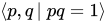
is the equational presentation for the bicyclic monoid, and

is the plactic monoid of degree 2 (it has infinite order). Elements of this plactic monoid may be written as 
02Inverse monoids and semigroups
Presentations of inverse monoids and semigroups can be defined in a similar way using a pair
where

is the free monoid with involution on 

is a binary relation between words. We denote by 

We use this pair of objects to define an inverse monoid

Let 

presented by 

In the previous discussion, if we replace everywhere 


A trivial but important example is the free inverse monoid (or free inverse semigroup) on 


or

Sources and credits
This article is adapted from the Wikipedia article “Presentation of a monoid”, written by its contributors and licensed under CC BY-SA 4.0. Fathomly has changed the layout, removed citation markers, navigation and maintenance notices, and adjusted punctuation. This adapted version is shared under the same license. For references, see the original article.
Fathomly is not affiliated with or endorsed by the Wikimedia Foundation. Spotted a problem? Tell us.