Modus tollens
Rule of logical inference
In propositional logic, modus tollens (/ˈmoʊdəs ˈtɒlɛnz/) (MT), also known as modus tollendo tollens (Latin for "mode that by denying denies") and denying the consequent, is a deductive argument form and a rule of inference. Modus tollens is a mixed hypothetical syllogism that takes the form of "If P, then Q. Not Q. Therefore, not P." It is an application of the general truth that if a statement is true, then so is its contrapositive. The form shows that inference from P implies Q to the negation of Q implies the negation of P is a valid argument.
The history of the inference rule modus tollens goes back to antiquity. The first to explicitly describe the argument form modus tollens was Theophrastus.
Modus tollens is closely related to modus ponens. There are two similar, but invalid, forms of argument: affirming the consequent and denying the antecedent. See also contraposition and proof by contrapositive.
01Explanation
The form of a modus tollens argument is a mixed hypothetical syllogism, with two premises and a conclusion:
- If P, then Q.
- Not Q.
- Therefore, not P.
The first premise is a conditional ("if-then") claim, such as P implies Q. The second premise is an assertion that Q, the consequent of the conditional claim, is not the case. From these two premises it can be logically concluded that P, the antecedent of the conditional claim, is also not the case.
For example:
- If the dog detects an intruder, the dog will bark.
- The dog did not bark.
- Therefore, no intruder was detected by the dog.
Supposing that the premises are both true (the dog will bark if it detects an intruder, and does indeed not bark), it logically follows that no intruder has been detected. This is a valid argument since it is not possible for the conclusion to be false if the premises are true. (It is conceivable that there may have been an intruder that the dog did not detect, but that does not invalidate the argument; the first premise is "if the dog detects an intruder". The thing of importance is that the dog detects or does not detect an intruder, not whether there is one.)
Example 1:
- If I am the burglar, then I can crack a safe.
- I cannot crack a safe.
- Therefore, I am not the burglar.
Example 2:
- If Rex is a chicken, then he is a bird.
- Rex is not a bird.
- Therefore, Rex is not a chicken.
02Relation to modus ponens
Every use of modus tollens can be converted to a use of modus ponens and one use of contraposition to the premise which is a material implication. For example:
- If P, then Q. (premise, material implication)
- If not Q, then not P. (derived by contraposition)
- Not Q . (premise)
- Therefore, not P. (derived by modus ponens)
Likewise, every use of modus ponens can be converted to a use of modus tollens and contraposition.
03Formal notation
The modus tollens rule can be stated formally as:
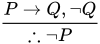
where 


The modus tollens rule may be written in sequent notation:

where 
or as the statement of a functional tautology or theorem of propositional logic:

where 

or including assumptions:
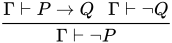
though since the rule does not change the set of assumptions, this is not strictly necessary.
More complex rewritings involving modus tollens are often seen, for instance in set theory:


("P is a subset of Q. x is not in Q. Therefore, x is not in P.")
Also in first-order predicate logic:



("For all x if x is P then x is Q. y is not Q. Therefore, y is not P.")
Strictly speaking these are not instances of modus tollens, but they may be derived from modus tollens using a few extra steps.
04Justification via truth table
The validity of modus tollens can be clearly demonstrated through a truth table.
| p | q | p → q |
|---|---|---|
| T | T | T |
| T | F | F |
| F | T | T |
| F | F | T |
In instances of modus tollens we assume as premises that p → q is true and q is false. There is only one line of the truth table, the fourth line, which satisfies these two conditions. In this line, p is false. Therefore, in every instance in which p → q is true and q is false, p must also be false.
05Formal proof
Via disjunctive syllogism
| Step | Proposition | Derivation |
|---|---|---|
| 1 |  | Given |
| 2 | | Given |
| 3 |  | Material implication (1) |
| 4 | | Disjunctive syllogism (3,2) |
Via reductio ad absurdum
| Step | Proposition | Derivation |
|---|---|---|
| 1 | | Given |
| 2 | | Given |
| 3 | | Assumption |
| 4 | | Modus ponens (1,3) |
| 5 |  | Conjunction introduction (2,4) |
| 6 | | Reductio ad absurdum (3,5) |
Via contraposition
| Step | Proposition | Derivation |
|---|---|---|
| 1 | | Given |
| 2 | | Given |
| 3 |  | Contraposition (1) |
| 4 | | Modus ponens (2,3) |
06Correspondence to other mathematical frameworks
Probability calculus
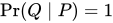
Modus tollens represents an instance of the law of total probability combined with Bayes' theorem expressed as:

where the conditionals 



In the equations above 




Subjective logic
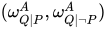
Modus tollens represents an instance of the abduction operator in subjective logic expressed as:

where 


Sources and credits
This article is adapted from the Wikipedia article “Modus tollens”, written by its contributors and licensed under CC BY-SA 4.0. Fathomly has changed the layout, removed citation markers, navigation and maintenance notices, and adjusted punctuation. This adapted version is shared under the same license. For references, see the original article.
Fathomly is not affiliated with or endorsed by the Wikimedia Foundation. Spotted a problem? Tell us.