Mixed complementarity problem
Formulation in mathematical programming
Mixed Complementarity Problem (MCP) is a problem formulation in mathematical programming. Many well-known problem types are special cases of, or may be reduced to MCP. It is a generalization of nonlinear complementarity problem (NCP).
01Definition
The mixed complementarity problem is defined by a mapping 

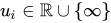
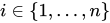
The solution of the MCP is a vector 
;
;
.
Another definition for MCP is: it is a variational inequality on the parallelepiped ![[\ell ,u]](https://wikimedia.org/api/rest_v1/media/math/render/svg/a4c4362328481e2983f23a396f2dc77d0f092387)
Sources and credits
This article is adapted from the Wikipedia article “Mixed complementarity problem”, written by its contributors and licensed under CC BY-SA 4.0. Fathomly has changed the layout, removed citation markers, navigation and maintenance notices, and adjusted punctuation. This adapted version is shared under the same license. For references, see the original article.
Fathomly is not affiliated with or endorsed by the Wikimedia Foundation. Spotted a problem? Tell us.