Minimum deviation
Condition when the angle of deviation is minimal in a prism

In a prism, the angle of deviation (δ) decreases with increase in the angle of incidence (i) up to a particular angle. This angle of incidence, where the angle of deviation in a prism is minimum, is called the minimum deviation position of the prism, and that very deviation angle is known as the minimum angle of deviation (denoted by δmin, Dλ, or Dm).
The angle of minimum deviation is related to the refractive index as:
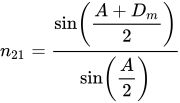
This is useful to calculate the refractive index of a material. Rainbows and haloes occur at minimum deviation. Also, a thin prism is always set at minimum deviation.
01Formula
In minimum deviation, the refracted ray in the prism is parallel to its base. In other words, the light ray is symmetrical about the axis of symmetry of the prism. Also, the angles of refractions are equal i.e. r1 = r2. The angle of incidence and angle of emergence equal each other (i = e). This is clearly visible in the graph below.
The formula for minimum deviation can be derived by exploiting the geometry in the prism. The approach involves replacing the variables in the Snell's law in terms of the Deviation and Prism Angles by making the use of the above properties.
From the angle sum of 


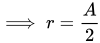
Using the exterior angle theorem in 




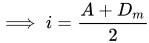
This can also be derived by putting i = e in the prism formula: i + e = A + δ
From Snell's law,

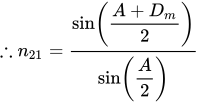

(where n is the refractive index, A is the Angle of Prism and Dm is the Minimum Angle of Deviation.)
This is a convenient way used to measure the refractive index of a material(liquid or gas) by directing a light ray through a prism of negligible thickness at minimum deviation filled with the material or in a glass prism dipped in it.
Worked out examples:
| The refractive index of glass is 1.5. The minimum angle of deviation for an equilateral prism along with the corresponding angle of incidence is desired. |
|---|
|
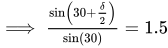
Answer: 37°, 49° Solution: Here, A = 60°, n = 1.5 Plugging them in the above formula, Also, This is also apparent in the graph below. |







| If the minimum angle of deviation of a prism of refractive index 1.4 equals its refracting angle, the angle of the prism is desired. |
|---|
|
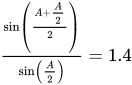
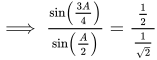
Answer: 60° Solution: Here,
Using the above formula, |




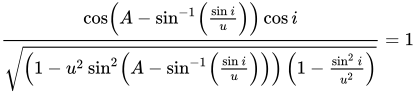
Also, the variation of the angle of deviation with an arbitrary angle of incidence can be encapsulated into a single equation by expressing δ in terms of i in the prism formula using Snell's law:

Finding the minima of this equation will also give the same relation for minimum deviation as above.
Putting 
For thin prism
In a thin or small angle prism, as the angles become very small, the sine of the angle nearly equals the angle itself and this yields many useful results.
Because Dm and A are very small,
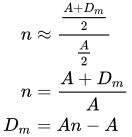

Using a similar approach with the Snell's law and the prism formula for an in general thin-prism ends up in the very same result for the deviation angle.
Because i, e and r are small,
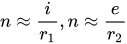
From the prism formula,
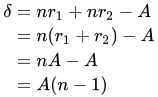
Thus, it can be said that a thin prism is always in minimum deviation.


02Experimental determination
Minimum deviation can be found manually or with spectrometer. Either the prism is kept fixed and the incidence angle is adjusted or the prism is rotated keeping the light source fixed.

03Minimum angle of dispersion
The minimum angle of dispersion for white light is the difference in minimum deviation angle between red and violet rays of a light ray through a prism.
For a thin prism, the deviation of violet light, 





04Applications
One of the factors that causes a rainbow is the bunching of light rays at the minimum deviation angle that is close to the rainbow angle (42°).
It is also responsible for phenomena like haloes and sundogs, produced by the deviation of sunlight in mini prisms of hexagonal ice crystals in the air bending light with a minimum deviation of 22°.

Sources and credits
This article is adapted from the Wikipedia article “Minimum deviation”, written by its contributors and licensed under CC BY-SA 4.0. Fathomly has changed the layout, removed citation markers, navigation and maintenance notices, and adjusted punctuation. This adapted version is shared under the same license. For references, see the original article.
Images, from Wikimedia Commons:
- Deflection of light ray passing through prism.png by PhysicsR, CC BY-SA 3.0
- Deviation angle of a beam of light entering a medium with refractive index.png by PhysicsR, CC0
- Minimum deflection of light ray passing through prism.png by PhysicsR, CC BY-SA 3.0
- Minimum deviation.png by Shubhrajit Sadhukhan, CC BY-SA 4.0
- Prisms-disp-diag02.jpg by a-level physics tutor, CC BY-SA 4.0
- Rainbow1.svg by KES47, Public domain
- 22 Degree halo Rotating Hexagonal Ice Crystal Complete cycle.gif by Dave3457, Public domain
Fathomly is not affiliated with or endorsed by the Wikimedia Foundation. Spotted a problem? Tell us.

