Reference articles on history, science, culture and more
Encyclopedia

Midpoint method

Numeric solution for differential equations

Image credit is listed at the end of this article.

In numerical analysis, a branch of applied mathematics, the midpoint method is a one-step method for numerically solving the differential equation,

y'(t)=f(t,y(t)),\quad y(t_{0})=y_{0}.

The explicit midpoint method is given by the formula

y_{n+1}=y_{n}+hf\left(t_{n}+{\frac {h}{2}},y_{n}+{\frac {h}{2}}f(t_{n},y_{n})\right), 1e

the implicit midpoint method by

y_{n+1}=y_{n}+hf\left(t_{n}+{\frac {h}{2}},{\frac {1}{2}}(y_{n}+y_{n+1})\right), 1i

for n=0,1,2,\dots Here, h is the step size , a small positive number, t_{n}=t_{0}+nh, and y_{n} is the computed approximate value of y(t_{n}). The explicit midpoint method is sometimes also known as the modified Euler method, the implicit method is the most simple collocation method, and, applied to Hamiltonian dynamics, a symplectic integrator. Note that the modified Euler method can refer to Heun's method, for further clarity see List of Runge-Kutta methods.

The name of the method comes from the fact that in the formula above, the function f giving the slope of the solution is evaluated at t=t_{n}+h/2={\tfrac {t_{n}+t_{n+1}}{2}}, the midpoint between t_{n} at which the value of y(t) is known and t_{n+1} at which the value of y(t) needs to be found.

A geometric interpretation may give a better intuitive understanding of the method (see figure at right). In the basic Euler's method, the tangent of the curve at (t_{n},y_{n}) is computed using f(t_{n},y_{n}). The next value y_{n+1} is found where the tangent intersects the vertical line t=t_{n+1}. However, if the second derivative is only positive between t_{n} and t_{n+1}, or only negative (as in the diagram), the curve will increasingly veer away from the tangent, leading to larger errors as h increases. The diagram illustrates that the tangent at the midpoint (upper, green line segment) would most likely give a more accurate approximation of the curve in that interval. However, this midpoint tangent could not be accurately calculated because we do not know the curve (that is what is to be calculated). Instead, this tangent is estimated by using the original Euler's method to estimate the value of y(t) at the midpoint, then computing the slope of the tangent with f(). Finally, the improved tangent is used to calculate the value of y_{n+1} from y_{n}. This last step is represented by the red chord in the diagram. Note that the red chord is not exactly parallel to the green segment (the true tangent), due to the error in estimating the value of y(t) at the midpoint.

The local error at each step of the midpoint method is of order O\left(h^{3}\right), giving a global error of order O\left(h^{2}\right). Thus, while more computationally intensive than Euler's method, the midpoint method's error generally decreases faster as h\to 0.

The methods are examples of a class of higher-order methods known as Runge-Kutta methods.

01Derivation of the midpoint method

The midpoint method is a refinement of the Euler method

y_{n+1}=y_{n}+hf(t_{n},y_{n}),\,

and is derived in a similar manner. The key to deriving Euler's method is the approximate equality

y(t+h)\approx y(t)+hf(t,y(t)) 2

which is obtained from the slope formula
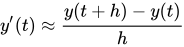
y'(t)\approx {\frac {y(t+h)-y(t)}{h}} 3

and keeping in mind that y'=f(t,y).

For the midpoint methods, one replaces (3) with the more accurate
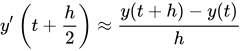
y'\left(t+{\frac {h}{2}}\right)\approx {\frac {y(t+h)-y(t)}{h}}

when instead of (2) we find

y(t+h)\approx y(t)+hf\left(t+{\frac {h}{2}},y\left(t+{\frac {h}{2}}\right)\right). 4

One cannot use this equation to find y(t+h) as one does not know y at t+h/2. The solution is then to use a Taylor series expansion exactly as if using the Euler method to solve for y(t+h/2):

y\left(t+{\frac {h}{2}}\right)\approx y(t)+{\frac {h}{2}}y'(t)=y(t)+{\frac {h}{2}}f(t,y(t)),

which, when plugged in (4), gives us

y(t+h)\approx y(t)+hf\left(t+{\frac {h}{2}},y(t)+{\frac {h}{2}}f(t,y(t))\right)

and the explicit midpoint method (1e).

The implicit method (1i) is obtained by approximating the value at the half step t+h/2 by the midpoint of the line segment from y(t) to y(t+h)

y\left(t+{\frac {h}{2}}\right)\approx {\frac {1}{2}}{\bigl (}y(t)+y(t+h){\bigr )}

and thus

{\frac {y(t+h)-y(t)}{h}}\approx y'\left(t+{\frac {h}{2}}\right)\approx k=f\left(t+{\frac {h}{2}},{\frac {1}{2}}{\bigl (}y(t)+y(t+h){\bigr )}\right)

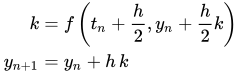
Inserting the approximation y_{n}+h\,k for y(t_{n}+h) results in the implicit Runge-Kutta method

{\begin{aligned}k&=f\left(t_{n}+{\frac {h}{2}},y_{n}+{\frac {h}{2}}k\right)\\y_{n+1}&=y_{n}+h\,k\end{aligned}}

which contains the implicit Euler method with step size h/2 as its first part.

Because of the time symmetry of the implicit method, all terms of even degree in h of the local error cancel, so that the local error is automatically of order {\mathcal {O}}(h^{3}). Replacing the implicit with the explicit Euler method in the determination of k results again in the explicit midpoint method.

Illustration of numerical integration for the equation Blue: the Euler method, green: the midpoint method, red: the exact solution, The step size is
The same illustration for It is seen that the midpoint method converges faster than the Euler method.
Watch videos about Midpoint methodExplainers and documentaries on YouTube (opens in a new tab)

Sources and credits

This article is adapted from the Wikipedia article Midpoint method, written by its contributors and licensed under CC BY-SA 4.0. Fathomly has changed the layout, removed citation markers, navigation and maintenance notices, and adjusted punctuation. This adapted version is shared under the same license. For references, see the original article.

Images, from Wikimedia Commons:

Fathomly is not affiliated with or endorsed by the Wikimedia Foundation. Spotted a problem? Tell us.