Midpoint circle algorithm
Determines the points needed for rasterizing a circle

In computer graphics, the midpoint circle algorithm is an algorithm used to determine the points needed for rasterizing a circle. It is a generalization of Bresenham's line algorithm. The algorithm can be further generalized to conic sections.
01Summary
This algorithm draws all eight octants simultaneously, starting from each cardinal direction (0°, 90°, 180°, 270°) and extends both ways to reach the nearest multiple of 45° (45°, 135°, 225°, 315°). It can determine where to stop because, when y = x, it has reached 45°. The reason for using these angles is shown in the above picture: As x increases, it neither skips nor repeats any x value until reaching 45°. So during the while loop, x increments by 1 with each iteration, and y decrements by 1 on occasion, never exceeding 1 in one iteration. This changes at 45° because that is the point where the tangent is rise=run. Whereas rise>run before and rise<run after.
The second part of the problem, the determinant, is far trickier. This determines when to decrement y. It usually comes after drawing the pixels in each iteration, because it never goes below the radius on the first pixel. Because in a continuous function, the function for a sphere is the function for a circle with the radius dependent on z (or whatever the third variable is), it stands to reason that the algorithm for a discrete (voxel) sphere would also rely on the midpoint circle algorithm. But when looking at a sphere, the integer radius of some adjacent circles is the same, but it is not expected to have the same exact circle adjacent to itself in the same hemisphere. Instead, a circle of the same radius needs a different determinant, to allow the curve to come in slightly closer to the center or extend out farther.

02Algorithm
The objective of the algorithm is to approximate a circle or, more formally, the curve 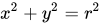


The "fast" direction in the first octant (the basis vector with the greater increase in value) is the 


The choice is made by computing the distance between the decision midpoint 


The iteration ends once the 45° slope line 

Variant with integer-based arithmetic
Just as with the parent Bresenham's line algorithm, this algorithm can be optimized to use only integer-based math. We start by defining the radius error 


To eliminate the 

Together with the condition on 

An initial value 


This optimized algorithm can be implemented in Python as follows:
import numpy as np # only for the image array r = 67 # radius of the circle img = np.zeros([2 * r + 1]*2, dtype=int) # image of size (2r + 1) x (2r + 1) to fit the circle x, y, p = r, 0, 1 - r # initial values x0 = r, y0 = 0, p0 = 1 - r while x >= y: # while the point (x, y) is in the first octant for j, k in [(1, 1), (1, -1), (-1, 1), (-1, -1)]: # draw to all quadrants img[j * x + r, k * y + r] = 1 img[k * y + r, j * x + r] = 1 x, y = x - (1 if p > 0 else 0), y + 1 # update x and y according to the radius error p p += 1 - 2 * x + 2 * y if p > 0 else 1 + 2 * y # update the radius error p with updated x and yJesko's method
An improved midpoint circle algorithm only requires 5 arithmetic operations per step (for 8 pixels) and is thus best suitable for low-performance systems. The counted operations in the main loop are:
- The comparison x >= y (is counted as a subtraction: x - y >= 0)
- y=y+1 [y++]
- t1 + y
- t1 - x
- The comparison t2 >= 0 is not counted as no real arithmetic takes place. In two's complement representation of the variables, only the sign bit has to be compared.
- x=x-1 [x--]
Operations: 5
t1 = r / 16 x = r y = 0 Repeat Until x < y Pixel (x, y) and all symmetric pixels are colored (8 times) y = y + 1 t1 = t1 + y t2 = t1 - x If t2 >= 0 t1 = t2 x = x - 103Drawing incomplete octants
The implementations above always draw only complete octants or circles. To draw only a certain arc from an angle 

If the angles are given as slopes, then no trigonometry or square roots are necessary: simply check that 
04Generalizations
Sources and credits
This article is adapted from the Wikipedia article “Midpoint circle algorithm”, written by its contributors and licensed under CC BY-SA 4.0. Fathomly has changed the layout, removed citation markers, navigation and maintenance notices, and adjusted punctuation. This adapted version is shared under the same license. For references, see the original article.
Images, from Wikimedia Commons:
- Midpoint circle algorithm animation (radius 23).gif by Psiĥedelisto, CC BY 4.0
- Midpoint circle algorithm radius 23.svg by FabriceReix, CC0
Fathomly is not affiliated with or endorsed by the Wikimedia Foundation. Spotted a problem? Tell us.