Metallic mean
Generalization of golden and silver ratios

The metallic mean (also metallic ratio, metallic constant, or noble mean) of a natural number n is a positive real number, denoted here 
- the unique positive real number
such that
- the positive root of the quadratic equation
- the number
- the number whose expression as a continued fraction is

![[n;n,n,n,n,\dots ]=n+{\cfrac {1}{n+{\cfrac {1}{n+{\cfrac {1}{n+{\cfrac {1}{n+\ddots \,}}}}}}}}](https://wikimedia.org/api/rest_v1/media/math/render/svg/aacef928564d8ef9feeb99ad23cac3109c3a0f31)
Metallic means are (successive) derivations of the golden (


In terms of algebraic number theory, the metallic means are exactly the real quadratic integers that are greater than 

The defining equation 

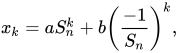
where 


For example, if 





01Geometry
The defining equation 
Consider a rectangle such that the ratio of its length L to its width W is the nth metallic ratio. If one remove from this rectangle n squares of side length W, one gets a rectangle similar to the original rectangle; that is, a rectangle with the same ratio of the length to the width (see figures).
Some metallic means appear as segments in the figure formed by a regular polygon and its diagonals. This is in particular the case for the golden ratio and the pentagon, and for the silver ratio and the octagon; see figures.

02Powers
Denoting by 

where the numbers 

Proof: The equality is immediately true for 



End of the proof.
One has also
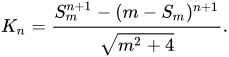
The odd powers of a metallic mean are themselves metallic means. More precisely, if n is an odd natural number, then 




Proof: Let 







This completes the proof, given that the initial values are easy to verify.
In particular, one has
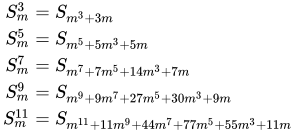
and, in general,
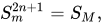
where
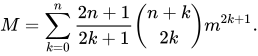
For even powers, things are more complicated. If n is a positive even integer then

Additionally,


For the square of a metallic ratio we have:
![S_{m}^{2}=[m{\sqrt {m^{2}+4}}+(m+2)]/2=(p+{\sqrt {p^{2}+4}})/2](https://wikimedia.org/api/rest_v1/media/math/render/svg/f9adf667465015ff5f9588e7b9fa4fc0fa9a3607)
where 


03Generalization
One may define the metallic mean 


Another generalization consists of changing the defining equation from 
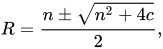
is any root of the equation, one has

The silver mean of m is also given by the integral

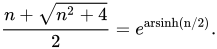
Another form of the metallic mean is
04Relation to half-angle cotangent
A tangent half-angle formula gives


05Relation to Pythagorean triples
For a primitive Pythagorean triple, a2 + b2 = c2, with positive integers a < b < c that are relatively prime, if the difference between the hypotenuse c and longer leg b is 1, 2 or 8 then the Pythagorean triangle exhibits a metallic mean. Specifically, the cotangent of one quarter of the smaller acute angle of the Pythagorean triangle is a metallic mean.
More precisely, for a primitive Pythagorean triple (a, b, c) with a < b < c, the smaller acute angle α satisfies


The reverse direction also works. For n ≥ 5, the primitive Pythagorean triple that gives the n-th metallic mean is given by (n, n2/4 − 1, n2/4 + 1) if n is a multiple of 4, is given by (n/2, (n2 − 4)/8, (n2 + 4)/8) if n is even but not a multiple of 4, and is given by (4n, n2 − 4, n2 + 4) if n is odd. For example, the primitive Pythagorean triple (20, 21, 29) gives the 5th metallic mean; (3, 4, 5) gives the 6th metallic mean; (28, 45, 53) gives the 7th metallic mean; (8, 15, 17) gives the 8th metallic mean; and so on.
06Numerical values
| First metallic means | |||
|---|---|---|---|
| n | Ratio | Value | Name |
 |  | ||
| 0 |  | 1 | |
| 1 |  | 1.618033988... | Golden |
| 2 |  | 2.414213562... | Silver |
| 3 |  | 3.302775637... | Bronze |
| 4 |  | 4.236067977... | |
| 5 |  | 5.192582403... | |
| 6 |  | 6.162277660... | |
| 7 |  | 7.140054944... | |
| 8 |  | 8.123105625... | |
| 9 |  | 9.109772228... | |
| 10 |  | 10.099019513... | |
07Relation to Aperiodic Order
The 


Sources and credits
This article is adapted from the Wikipedia article “Metallic mean”, written by its contributors and licensed under CC BY-SA 4.0. Fathomly has changed the layout, removed citation markers, navigation and maintenance notices, and adjusted punctuation. This adapted version is shared under the same license. For references, see the original article.
Images, from Wikimedia Commons:
- Fibonacci spiral 34.svg by Dicklyon, Public domain
- Gold, silver, and bronze rectangles.svg by Rubber Duck (☮ • ✍), Public domain
- AgamRiaSanga.png by Bababoidbl, CC0
Fathomly is not affiliated with or endorsed by the Wikimedia Foundation. Spotted a problem? Tell us.
