Reference articles on history, science, culture and more
Encyclopedia

Mean signed deviation

In statistics, the mean signed difference (MSD), also known as mean signed deviation, mean signed error, or mean bias error is a sample statistic that summarizes how well a set of estimates {\hat {\theta }}_{i} match the quantities \theta _{i} that they are supposed to estimate. It is one of a number of statistics that can be used to assess an estimation procedure, and it would often be used in conjunction with a sample version of the mean square error.

For example, suppose a linear regression model has been estimated over a sample of data, and is then used to extrapolate predictions of the dependent variable out of sample after the out-of-sample data points have become available. Then \theta _{i} would be the i-th out-of-sample value of the dependent variable, and {\hat {\theta }}_{i} would be its predicted value. The mean signed deviation is the average value of {\hat {\theta }}_{i}-\theta _{i}.

01Definition

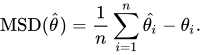
The mean signed difference is derived from a set of n pairs, ({\hat {\theta }}_{i},\theta _{i}), where {\hat {\theta }}_{i} is an estimate of the parameter \theta in a case where it is known that \theta =\theta _{i}. In many applications, all the quantities \theta _{i} will share a common value. When applied to forecasting in a time series analysis context, a forecasting procedure might be evaluated using the mean signed difference, with {\hat {\theta }}_{i} being the predicted value of a series at a given lead time and \theta _{i} being the value of the series eventually observed for that time-point. The mean signed difference is defined to be

\operatorname {MSD} ({\hat {\theta }})={\frac {1}{n}}\sum _{i=1}^{n}{\hat {\theta _{i}}}-\theta _{i}.

02Use Cases

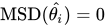
The mean signed difference is often useful when the estimations {\hat {\theta _{i}}} are biased from the true values \theta _{i} in a certain direction. If the estimator that produces the {\hat {\theta _{i}}} values is unbiased, then \operatorname {MSD} ({\hat {\theta _{i}}})=0. However, if the estimations {\hat {\theta _{i}}} are produced by a biased estimator, then the mean signed difference is a useful tool to understand the direction of the estimator's bias.

Watch videos about Mean signed deviationExplainers and documentaries on YouTube (opens in a new tab)

Sources and credits

This article is adapted from the Wikipedia article Mean signed deviation, written by its contributors and licensed under CC BY-SA 4.0. Fathomly has changed the layout, removed citation markers, navigation and maintenance notices, and adjusted punctuation. This adapted version is shared under the same license. For references, see the original article.

Fathomly is not affiliated with or endorsed by the Wikimedia Foundation. Spotted a problem? Tell us.