Maximal information coefficient
Statistical measure of association between variables
In statistics, the maximal information coefficient (MIC) is a measure of the strength of the linear or non-linear association between two variables X and Y.
The MIC belongs to the maximal information-based nonparametric exploration (MINE) class of statistics. In a simulation study, MIC outperformed some selected low power tests, however concerns have been raised regarding reduced statistical power in detecting some associations in settings with low sample size when compared to powerful methods such as distance correlation and Heller-Heller, Gorfine (HHG). Comparisons with these methods, in which MIC was outperformed, were made in Simon and Tibshirani and in Gorfine, Heller, and Heller. It is claimed that MIC approximately satisfies a property called equitability which is illustrated by selected simulation studies. It was later proved that no non-trivial coefficient can exactly satisfy the equitability property as defined by Reshef et al., although this result has been challenged. Some criticisms of MIC are addressed by Reshef et al. in further studies published on arXiv.
01Overview
The maximal information coefficient uses binning as a means to apply mutual information on continuous random variables. Binning has been used for some time as a way of applying mutual information to continuous distributions; what MIC contributes in addition is a methodology for selecting the number of bins and picking a maximum over many possible grids.
The rationale is that the bins for both variables should be chosen in such a way that the mutual information between the variables be maximal. That is achieved whenever 


Because the variables X and Y are real numbers, it is almost always possible to create exactly one bin for each (x,y) datapoint, and that would yield a very high value of the MI. To avoid forming this kind of trivial partitioning, the authors of the paper propose taking a number of bins 

In some cases it is possible to achieve a good correspondence between 





Last, the normalized maximal mutual information value for different combinations of
Trying all possible binning schemes that satisfy 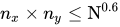
Sources and credits
This article is adapted from the Wikipedia article “Maximal information coefficient”, written by its contributors and licensed under CC BY-SA 4.0. Fathomly has changed the layout, removed citation markers, navigation and maintenance notices, and adjusted punctuation. This adapted version is shared under the same license. For references, see the original article.
Fathomly is not affiliated with or endorsed by the Wikimedia Foundation. Spotted a problem? Tell us.