Matrix geometric method
Method of analysis in probability theory
In probability theory, the matrix geometric method is a method for the analysis of quasi-birth-death processes, continuous-time Markov chain whose transition rate matrix has a repetitive block structure. The method was developed "largely by Marcel F. Neuts and his students starting around 1975."
01Method description
The method requires a transition rate matrix with tridiagonal block structure as follows
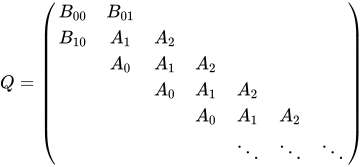
where each of B00, B01, B10, A0, A1 and A2 are matrices. To compute the stationary distribution π writing π Q = 0 the balance equations are considered for sub-vectors πi
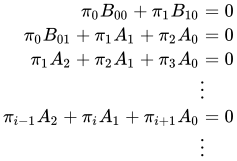
Observe that the relationship

holds where R is the Neuts' rate matrix, which can be computed numerically. Using this we write

which can be solve to find π0 and π1 and therefore iteratively all the πi.
02Computation of R
The matrix R can be computed using cyclic reduction or logarithmic reduction.
03Matrix analytic method
The matrix analytic method is a more complicated version of the matrix geometric solution method used to analyse models with block M/G/1 matrices. Such models are harder because no relationship like πi = π1 Ri , 1 used above holds.
Sources and credits
This article is adapted from the Wikipedia article “Matrix geometric method”, written by its contributors and licensed under CC BY-SA 4.0. Fathomly has changed the layout, removed citation markers, navigation and maintenance notices, and adjusted punctuation. This adapted version is shared under the same license. For references, see the original article.
Fathomly is not affiliated with or endorsed by the Wikimedia Foundation. Spotted a problem? Tell us.