Mathieu wavelet
The Mathieu equation is a linear second-order differential equation with periodic coefficients. The French mathematician, E. Léonard Mathieu, first introduced this family of differential equations, nowadays termed Mathieu equations, in his “Memoir on vibrations of an elliptic membrane” in 1868. "Mathieu functions are applicable to a wide variety of physical phenomena, e.g., diffraction, amplitude distortion, inverted pendulum, stability of a floating body, radio frequency quadrupole, and vibration in a medium with modulated density"
01Elliptic-cylinder wavelets
This is a wide family of wavelet system that provides a multiresolution analysis. The magnitude of the detail and smoothing filters corresponds to first-kind Mathieu functions with odd characteristic exponent. The number of notches of these filters can be easily designed by choosing the characteristic exponent. Elliptic-cylinder wavelets derived by this method possess potential application in the fields of optics and electromagnetism due to its symmetry.

02Mathieu differential equations
Mathieu's equation is related to the wave equation for the elliptic cylinder. In 1868, the French mathematician Émile Léonard Mathieu introduced a family of differential equations nowadays termed Mathieu equations.
Given 
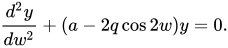
The Mathieu equation is a linear second-order differential equation with periodic coefficients. For q = 0, it reduces to the well-known harmonic oscillator, a being the square of the frequency.
The solution of the Mathieu equation is the elliptic-cylinder harmonic, known as Mathieu functions. They have long been applied on a broad scope of wave-guide problems involving elliptical geometry, including:
- analysis for weak guiding for step index elliptical core optical fibres
- power transport of elliptical wave guides
- evaluating radiated waves of elliptical horn antennas
- elliptical annular microstrip antennas with arbitrary eccentricity
)
- scattering by a coated strip.

03Mathieu functions: cosine-elliptic and sine-elliptic functions
In general, the solutions of Mathieu equation are not periodic. However, for a given q, periodic solutions exist for infinitely many special values (eigenvalues) of a. For several physically relevant solutions y must be periodic of period 

One of four simpler types can be considered: Periodic solution (
For 


ce and se are abbreviations for cosine-elliptic and sine-elliptic, respectively.
- Even periodic solution:
- Odd periodic solution:


where the sums are taken over even (respectively odd) values of m if the period of y is
Given r, we denote henceforth 

Interesting relationships are found when 

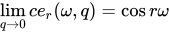
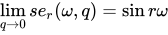
Figure 1 shows two illustrative waveform of elliptic cosines, whose shape strongly depends on the parameters
04Multiresolution analysis filters and Mathieu's equation
Wavelets are denoted by 


The equation 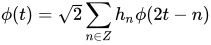
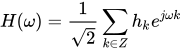
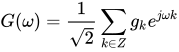
The transfer function of the "detail filter" of a Mathieu wavelet is
![G_{\nu }(\omega )=e^{j(\nu -2)[{\frac {\omega -\pi }{2}}]}.{\frac {ce_{\nu }({\frac {\omega -\pi }{2}},q)}{ce_{\nu }(0,q)}}.](https://wikimedia.org/api/rest_v1/media/math/render/svg/ca20fa1f4613610a39bcf196269fe1a9f73e69fa)
The transfer function of the "smoothing filter" of a Mathieu wavelet is
![H_{\nu }(\omega )=-e^{j\nu [{\frac {\omega }{2}}]}.{\frac {ce_{\nu }({\frac {\omega }{2}},q)}{ce_{\nu }(0,q)}}.](https://wikimedia.org/api/rest_v1/media/math/render/svg/a6dd4e63d3a43af3ff51857b544f1f742ed5ca1e)
The characteristic exponent 

The magnitude of the transfer function corresponds exactly to the modulus of an elliptic-sine:
Examples of filter transfer function for a Mathieu MRA are shown in the figure 2. The value of a is adjusted to an eigenvalue in each case, leading to a periodic solution. Such solutions present a number of 
The G and H filter coefficients of Mathieu MRA can be expressed in terms of the values 
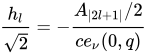
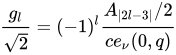
There exist recurrence relations among the coefficients:


for 
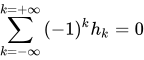
It is straightforward to show that 

Normalising conditions are 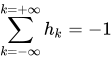

05Waveform of Mathieu wavelets
Mathieu wavelets can be derived from the lowpass reconstruction filter by the cascade algorithm. Infinite Impulse Response filters (IIR filter) should be use since Mathieu wavelet has no compact support. Figure 3 shows emerging pattern that progressively looks like the wavelet's shape. Depending on the parameters a and q some waveforms (e.g. fig. 3b) can present a somewhat unusual shape.
Sources and credits
This article is adapted from the Wikipedia article “Mathieu wavelet”, written by its contributors and licensed under CC BY-SA 4.0. Fathomly has changed the layout, removed citation markers, navigation and maintenance notices, and adjusted punctuation. This adapted version is shared under the same license. For references, see the original article.
Images, from Wikimedia Commons:
- Figura Mathieu1.PNG by Hmo, Public domain
- Figura Mathieu2.PNG by Hmo, Public domain
- Figura Mathieu3.PNG by Hmo, Public domain
Fathomly is not affiliated with or endorsed by the Wikimedia Foundation. Spotted a problem? Tell us.