Mach wave
Pressure wave

In fluid dynamics, a Mach wave, also known as a weak discontinuity, is a pressure wave traveling with the speed of sound caused by a slight change of pressure added to a compressible flow. These weak waves can combine in supersonic flow to become a shock wave if sufficient Mach waves are present at any location. Such a shock wave is called a Mach stem or Mach front. Thus, it is possible to have shockless compression or expansion in a supersonic flow by having the production of Mach waves sufficiently spaced (cf. isentropic compression in supersonic flows). A Mach wave is the weak limit of an oblique shock wave where time averages of flow quantities don't change (a normal shock is the other limit). If the size of the object moving at the speed of sound is near 0, then this domain of influence of the wave is called a Mach cone.
01Mach angle
A Mach wave propagates across the flow at the Mach angle μ, which is the angle formed between the Mach wave wavefront and a vector that points opposite to the vector of motion. It is given by
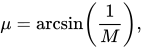
where M is the Mach number.
Mach waves can be used in schlieren or shadowgraph observations to determine the local Mach number of the flow. Early observations by Ernst Mach used grooves in the wall of a duct to produce Mach waves in a duct, which were then photographed by the schlieren method, to obtain data about the flow in nozzles and ducts. Mach angles may also occasionally be visualized out of their condensation in air, for example vapor cones around aircraft during transonic flight.

Sources and credits
This article is adapted from the Wikipedia article “Mach wave”, written by its contributors and licensed under CC BY-SA 4.0. Fathomly has changed the layout, removed citation markers, navigation and maintenance notices, and adjusted punctuation. This adapted version is shared under the same license. For references, see the original article.
Images, from Wikimedia Commons:
- Schlierenfoto Mach 1-2 Pfeilflügel - NASA.jpg by NASA, Public domain
- Sonic boom.svg by Melamed katz, CC BY-SA 3.0
Fathomly is not affiliated with or endorsed by the Wikimedia Foundation. Spotted a problem? Tell us.

