Yamaha M7CL
Mixing console

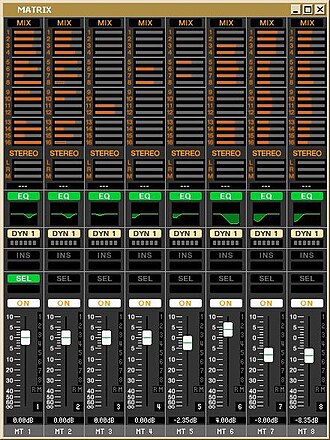
The Yamaha M7CL is a digital mixer that was introduced by Yamaha Pro Audio in 2005. Two models with onboard analog input exist: the M7CL-32 and M7CL-48. These models have 40 (32 microphone and 4 stereo line)- and 56 (48 microphone and 4 stereo line)-input channels respectively, counting mono channels. Mixes, masters, groups, DCAs and individual channels can then be routed to an output via any number of the board's 16 configurable output XLR ports. The eight faders of the master control section can control multiple functions by way of "layers" in the same manner as the Yamaha PM5D. The board features Yamaha's "Selected Channel" technology, and Centralogic, unique to the M7CL. It can be augmented with more inputs or outputs via expansion cards, and can be fitted with third-party cards such as ones made by Aviom (A-Net), AuviTran (EtherSound), Audinate (Dante networking), AudioService (MADI), Dan Dugan (automixer), Riedel Communications (RockNet), Waves Audio (SoundGrid interface, DSP plugins), and Optocore (optical network). In 2010, the M7CL-48ES joined the line-up with built-in EtherSound for digital networking using EtherSound stage boxes.
In 2006, the M7CL was recognized at the TEC Awards ceremony for best sound reinforcement console technology. In 2011, a wireless app to control the M7CL with an iPad was nominated but did not win the TEC Award for best wireless technology.
01Features
Selected channel
The selected channel interface allows for quick and easy access to every parameter of any channel on the board quickly and easily. Selecting a channel will pull up all available parameters into the Centralogic section for adjustment.
Centralogic
Centralogic is a technology new and unique to the M7CL. It employs a touch screen, rotary encoders, and faders that dynamically map to whatever function or parameter is selected for adjustment. The control software has only 3 main screens, Overview, Selected Channel, and Effects Rack views. There are no additional layers to navigate through. It is possible to control the mixer from the Centralogic section only and is designed to keep the user at the center section.
"Rack" equipment
The M7CL features a virtual signal processing "rack" which allows for the use of many different effects or Graphic EQs. Effects are from Yamaha's library of digital effects developed for other digital mixers. Of note is Graphic EQ operation, where the individual bands of EQ can be mapped to faders for precision control.

02Popularity
The M7CL became popular in both broadcasting and live sound reinforcement applications. Broadcast companies liked the console primarily for parameter recall, which is useful in daily news broadcasts. Live sound companies often used the mixer for stage monitoring purposes, but have also used it for Front of House environments.

Sources and credits
This article is adapted from the Wikipedia article “Yamaha M7CL”, written by its contributors and licensed under CC BY-SA 4.0. Fathomly has changed the layout, removed citation markers, navigation and maintenance notices, and adjusted punctuation. This adapted version is shared under the same license. For references, see the original article.
Images, from Wikimedia Commons:
- M7CL Full.jpg by Lpmusix at English Wikipedia, CC BY 2.5
- Yamaha M7CL with Dugan E automixer.jpg by Binksternet, CC BY-SA 3.0
- Yamaha M7CL 19x8 matrix.jpg by Binksternet, CC BY-SA 3.0
- M7CL Fader Shot.jpg by Lpmusix at English Wikipedia, CC BY 2.5
Fathomly is not affiliated with or endorsed by the Wikimedia Foundation. Spotted a problem? Tell us.
