Loop algebra
Type of Lie algebra of interest in physics
In mathematics, loop algebras are certain types of Lie algebras, of particular interest in theoretical physics.
01Definition
For a Lie algebra 

![K[t,t^{-1}]](https://wikimedia.org/api/rest_v1/media/math/render/svg/b9bf8b31d484ed0d11b27301560bc79c7b10ff33)
![L{\mathfrak {g}}:={\mathfrak {g}}\otimes K[t,t^{-1}],](https://wikimedia.org/api/rest_v1/media/math/render/svg/711d03b32f6ba9a09635e45d74df94d0f3222b46)
![[X\otimes t^{m},Y\otimes t^{n}]=[X,Y]\otimes t^{m+n}.](https://wikimedia.org/api/rest_v1/media/math/render/svg/4021d701209302e8c53baab46c42ecd367d9396b)
Geometric definition
If
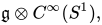
is an infinite-dimensional Lie algebra with the Lie bracket given by
![[g_{1}\otimes f_{1},g_{2}\otimes f_{2}]=[g_{1},g_{2}]\otimes f_{1}f_{2}.](https://wikimedia.org/api/rest_v1/media/math/render/svg/258e3496c273ecc9981999c11b9c0d0554b989b5)
Here g1 and g2 are elements of
This isn't precisely what would correspond to the direct product of infinitely many copies of
02Gradation
Defining 

![[\cdot \,,\,\cdot ]:{\mathfrak {g}}_{i}\times {\mathfrak {g}}_{j}\rightarrow {\mathfrak {g}}_{i+j},](https://wikimedia.org/api/rest_v1/media/math/render/svg/1c8c803d0cc6f1defe72f15455dbd13fb8d381fd)

In particular, the bracket restricts to the 'zero-mode' subalgebra 
03Derivation
There is a natural derivation on the loop algebra, conventionally denoted 



It is required to define affine Lie algebras, which are used in physics, particularly conformal field theory.
04Loop group
Similarly, a set of all smooth maps from S1 to a Lie group G forms an infinite-dimensional Lie group (Lie group in the sense we can define functional derivatives over it) called the loop group. The Lie algebra of a loop group is the corresponding loop algebra.
05Affine Lie algebras as central extension of loop algebras
If 
The central extension is given by adjoining a central element 
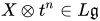
![[{\hat {k}},X\otimes t^{n}]=0,](https://wikimedia.org/api/rest_v1/media/math/render/svg/e7d212b73a852729e3b626c36a2f56dd0c7e2230)
![[X\otimes t^{m},Y\otimes t^{n}]=[X,Y]\otimes t^{m+n}+mB(X,Y)\delta _{m+n,0}{\hat {k}},](https://wikimedia.org/api/rest_v1/media/math/render/svg/a6514474c378e780f698ec77aa3450c54bb72ac2)

The central extension is, as a vector space, 

Cocycle
Using the language of Lie algebra cohomology, the central extension can be described using a 2-cocycle on the loop algebra. This is the map


Affine Lie algebra
In physics, the central extension 
On this space, the Killing form can be extended to a non-degenerate form, and so allows a root system analysis of the affine Lie algebra.
Sources and credits
This article is adapted from the Wikipedia article “Loop algebra”, written by its contributors and licensed under CC BY-SA 4.0. Fathomly has changed the layout, removed citation markers, navigation and maintenance notices, and adjusted punctuation. This adapted version is shared under the same license. For references, see the original article.
Fathomly is not affiliated with or endorsed by the Wikimedia Foundation. Spotted a problem? Tell us.