Longest common substring
Computer science problem
In computer science, a longest common substring of two or more strings is a longest string that is a substring of all of them. There may be more than one longest common substring. Applications include data deduplication and plagiarism detection.
Unlike the longest common subsequence problem, which finds insertions or deletions within the common text, the longest common substring problem seeks a contiguous substring shared by both texts.
01Examples
The picture shows two strings where the problem has multiple solutions. Although the substring occurrences always overlap, it is impossible to obtain a longer common substring by "uniting" them.
The strings "ABABC", "BABCA" and "ABCBA" have only one longest common substring, viz. "ABC" of length 3. Other common substrings are "A", "AB", "B", "BA", "BC" and "C".
ABABC ||| BABCA ||| ABCBA
02Problem definition
Given two strings, 


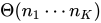
A generalization is the k-common substring problem. Given the set of strings 


03Algorithms
One can find the lengths and starting positions of the longest common substrings of 






Suffix tree
The longest common substrings of a set of strings can be found by building a generalized suffix tree for the strings, and then finding the deepest internal nodes which have leaf nodes from all the strings in the subtree below it. The figure on the right is the suffix tree for the strings "ABAB", "BABA" and "ABBA", padded with unique string terminators, to become "ABAB$0", "BABA$1" and "ABBA$2". The nodes representing "A", "B", "AB" and "BA" all have descendant leaves from all of the strings, numbered 0, 1 and 2.
Building the suffix tree takes 

Dynamic programming
The following pseudocode finds the set of longest common substrings between two strings with dynamic programming:
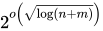
function LongestCommonSubstring(S[1..r], T[1..n]) L := array(1..r, 1..n) z := 0 # length of the longest common substring found so far ret := {} for i := 1..r for j := 1..n if S[i] = T[j] if i = 1 or j = 1 L[i, j] := 1 else L[i, j] := L[i − 1, j − 1] + 1 if L[i, j] > z z := L[i, j] ret := {S[(i − z + 1)..i]} else if L[i, j] = z ret := ret ∪ {S[(i − z + 1)..i]} else L[i, j] := 0 return retThis algorithm runs in 
The following tricks can be used to reduce the memory usage of an implementation:
- Keep only the last and current row of the DP table to save memory (
instead of
- The last and current row can be stored on the same 1D array by traversing the inner loop backwards
- Store only non-zero values in the rows. This can be done using hash-tables instead of arrays. This is useful for large alphabets.
Sources and credits
This article is adapted from the Wikipedia article “Longest common substring”, written by its contributors and licensed under CC BY-SA 4.0. Fathomly has changed the layout, removed citation markers, navigation and maintenance notices, and adjusted punctuation. This adapted version is shared under the same license. For references, see the original article.
Images, from Wikimedia Commons:
- Suffix tree ABAB BABA ABBA.svg by User:Joey-das-WBF, Public domain
Fathomly is not affiliated with or endorsed by the Wikimedia Foundation. Spotted a problem? Tell us.