List of logic symbols
In logic, a set of symbols is commonly used to express logical representation. The following table lists many common symbols, together with their name, how they should be read out loud, and the related field of mathematics. Additionally, the subsequent columns contain an informal explanation, a short example, the Unicode location, the name for use in HTML documents, and the LaTeX symbol.
01Propositional logic
| Logic Name | Symbol | Unicode value (hexadecimal) |
HTML codes |
LaTeX symbol |
Read as | Explanation | Diagram |
|---|---|---|---|---|---|---|---|
| Negation | ¬ | U+00AC | ¬ ¬ |  \lnot or \neg \lnot or \neg |
NOT |  |
|
| ~ | U+007E | ˜ ˜ |  \sim \sim | ||||
| ! | U+0021 | ! | \lnot or \neg | ||||
| ′ | U+2032 | ′ |  ' ' | ||||
| Conjunction | ∧ | U+2227 | ∧ ∧ |  \wedge or \land \wedge or \land |
AND |  |
|
| · | U+00B7 | · · |  \cdot \cdot | ||||
| & | U+0026 | & & |  \& \& | ||||
| Inclusive disjunction | ∨ | U+2228 | ∨ ∨ |  \lor or \vee \lor or \vee |
OR |  |
|
| + | U+002B | + + | |||||
| ∥ | U+2225 | ∥ ∥ |  \parallel \parallel | ||||
| Exclusive disjunction | ⊕ | U+2295 | ⊕ ⊕ |  \oplus \oplus |
XOR, either ... or ... |
 |
|
| ⊻ | U+22BB | ⊻ ⊻ |  \veebar \veebar | ||||
| ↮ | U+21AE | ↮ |  \nleftrightarrow \nleftrightarrow | ||||
| ≢ | U+2262 | ≢ ≢ |  \not\equiv \not\equiv | ||||
| Non-conjunction (Sheffer stroke) | ↑ | U+2191 |  \uparrow \uparrow |
NAND, neither ... nor ... |  |
||
| | | U+007C |  \vert, \mid \vert, \mid | |||||
| ⊼ | U+22BC |  \barwedge \barwedge | |||||
| Non-disjunction | ↓ | U+2193 |  \downarrow \downarrow |
NOR |  |
||
| ⊽ | U+22BD |  \overline{\vee} \overline{\vee} | |||||
| Conditional | ⇒ | U+21D2 | ⇒ ⇒ |  \Rightarrow \Rightarrow \implies \implies |
Implies, then |
 |
|
| → | U+2192 | → → |  \to or \rightarrow \to or \rightarrow | ||||
| ⊃ | U+2283 | ⊃ ⊃ |  \supset \supset | ||||
| Biconditional | ⇔ | U+21D4 | ⇔ ⇔ |  \Leftrightarrow \Leftrightarrow \iff \iff |
If and only if, iff, XNOR |  |
|
| ↔ | U+2194 | ↔ ↔ |  \leftrightarrow \leftrightarrow | ||||
| ≡ | U+2261 | ≡ ≡ |  \equiv \equiv | ||||
| ⊙ | U+2299 |  \odot \odot |
| Logic Name | Symbol | Unicode value (hexadecimal) |
HTML codes |
LaTeX symbol |
Read as | Category | Explanation | Examples |
|---|---|---|---|---|---|---|---|---|
| true (tautology) | ⊤ | U+22A4 | ⊤ ⊤ |  \top \top |
top, truth, tautology, verum, full clause | propositional logic, Boolean algebra, first-order logic | denotes a proposition that is always true. |
The proposition  is always true since at least one of the two is unconditionally true. is always true since at least one of the two is unconditionally true. |
| T | ||||||||
| 1 | ||||||||
| false (contradiction) | ⊥ | U+22A5 | ⊥ ⊥ |  \bot \bot |
bottom, falsity, contradiction, falsum, empty clause | propositional logic, Boolean algebra, first-order logic | denotes a proposition that is always false. The symbol ⊥ may also refer to perpendicular lines. |
The proposition  is always false since at least one of the two is unconditionally false. is always false since at least one of the two is unconditionally false. |
| F | ||||||||
| 0 | ||||||||
| precedence grouping | ( ) | U+0028 U+0029 | ( ) ( ) |  ( ) ( ) |
parentheses; brackets | almost all logic syntaxes, as well as metalanguage | Perform the operations inside the parentheses first. | (8 ÷ 4) ÷ 2 = 2 ÷ 2 = 1, but 8 ÷ (4 ÷ 2) = 8 ÷ 2 = 4. |
Advanced or rarely used
| Symbol | Unicode value (hexadecimal) |
Logic Name |
|---|---|---|
| ⌐ | U+2310 | reversed not sign |
| ⨇ | U+2A07 | two logical AND operator |


02First-order logic
| Symbol | Unicode value (hexadecimal) |
HTML codes |
LaTeX symbol |
Logic Name | Read as | Category | Explanation | Examples |
|---|---|---|---|---|---|---|---|---|
| ∀ | U+2200 | ∀ ∀ |  \forall \forall |
universal quantification | given any, for all, for every, for each, for any | first-order logic |   or or says "given any says "given any  , has property , has property  ." ." |
 |
| () | ||||||||
| ∃ | U+2203 | ∃ ∃ |  \exists \exists |
existential quantification | there exists, for some | first-order logic |  says "there exists an (at least one) such that has property ." says "there exists an (at least one) such that has property ." |
 n is even. n is even. |
| ∃! | U+2203 U+0021 | ∃ ! ∃! |  \exists ! \exists ! |
uniqueness quantification | there exists exactly one | first-order logic (abbreviation) |  says "there exists exactly one such that has property ." Only and are part of formal logic. is an abbreviation for says "there exists exactly one such that has property ." Only and are part of formal logic. is an abbreviation for  |
 |
Advanced or rarely used first-order symbols
| Symbol | Unicode value (hexadecimal) |
HTML value (decimal) |
HTML entity (named) |
LaTeX symbol |
Logic Name | Read as | Category | Explanation |
|---|---|---|---|---|---|---|---|---|
| ∄ | U+2204 | \nexists | there does not exist | Strike out existential quantifier. "¬∃" is sometimes used instead. |


03Metalanguage and metalogic
| Symbol | Unicode value (hexadecimal) |
HTML codes |
LaTeX symbol |
Logic Name | Read as | Category | Explanation | Examples |
|---|---|---|---|---|---|---|---|---|
 |
U+1D53B | 𝔻 𝔻 | \mathbb{D | domain of discourse | domain of discourse | metalanguage (first-order logic semantics) |  | |
| ⊢ | U+22A2 | ⊢ ⊢ |  \vdash \vdash |
syntactic consequence | proves, syntactically entails (single) turnstile | metalanguage (metalogic) |  says " says " is a theorem of is a theorem of  ". In other words, proves via a deductive system. ". In other words, proves via a deductive system. |
 (eg. by using natural deduction) |
| ⊨ | U+22A8 | ⊨ ⊨ |
 \vDash, \models \vDash, \models |
semantic consequence or satisfaction | (semantically) entails or satisfies, models double turnstile | metalanguage (metalogic) |  says says"in every model, it is not the case that is true and is false".
variable assignment |
 (eg. by using truth tables) |
| ≡ | U+2261 | ≡ | \equiv |
logical equivalence | is logically equivalent to | metalanguage (metalogic) | It's when and  . Whether a symbol means a material biconditional or a logical equivalence, depends on the author's style. . Whether a symbol means a material biconditional or a logical equivalence, depends on the author's style. |
 |
| ⟚ | U+27DA | |||||||
| ⇔ | U+21D4 | ⇔ ⇔ | \Leftrightarrow | |||||
| ⊬ | U+22AC | ⊬ \nvdash | does not syntactically entail (does not prove) | metalanguage (metalogic) |  says " is says " isnot a theorem of ".In other words, is not derivable from via a deductive system. |
 | ||
| ⊭ | U+22AD | ⊭\nvDash | does not semantically entail | metalanguage (metalogic) |  says " does not guarantee the truth of ". says " does not guarantee the truth of ".In other words, does not make true. |
 | ||
| ∴ | U+2234 | ∴\therefore | therefore | therefore | metalanguage | abbreviation for "therefore" | ||
| ∵ | U+2235 | ∵ \because | because | because | metalanguage | abbreviation for "because". | ||
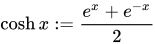
| ≔ | U+2254 | ≔ ≔ | ≔ \coloneqq := := |
definition | is defined as | metalanguage |  means "from now on, means "from now on,  is defined to be another name for is defined to be another name for  ." This is a statement in the metalanguage, not the object language. The notation ." This is a statement in the metalanguage, not the object language. The notation  may occasionally be seen in physics, meaning the same as . may occasionally be seen in physics, meaning the same as . |
 |
| ≜ | U+225C |  \triangleq \triangleq | ||||||
| ≝ | U+225D |  \stackrel{ \scriptscriptstyle \mathrm{def}}{=} |
 says
says with
with .
.Advanced or rarely used metalogical symbols
| Symbol | Unicode value (hexadecimal) |
LaTeX symbol |
Logic Name | Explanation |
|---|---|---|---|---|
| ̅ | U+0305 | \overline{x} | combining overline | Used format for denoting Gödel numbers. Using HTML style "4̅" is an abbreviation for the standard numeral "SSSS0".
It may also denote a negation (used primarily in electronics). |
| ⌜ ⌝ |
U+231C U+231D |
\ulcorner
\urcorner |
top left corner top right corner |
Corner quotes, also called "Quine quotes"; for quasi-quotation, i.e. quoting specific context of unspecified ("variable") expressions; also used for denoting Gödel number; for example "⌜G⌝" denotes the Gödel number of G. (Typographical note: although the quotes appears as a "pair" in unicode (231C and 231D), they are not symmetrical in some fonts. In some fonts (for example Arial) they are only symmetrical in certain sizes. Alternatively the quotes can be rendered as ⌈ and ⌉ (U+2308 and U+2309) or by using a negation symbol and a reversed negation symbol ⌐ ¬ in superscript mode.) |
| ⟛ | U+27DB | left and right tack | "Proves and is proved by". | |
| ⊩ | U+22A9 | \Vdash | forces | One of this symbol's uses is to mean "truthmakes" in the truthmaker theory of truth. It is also used to mean "forces" in the set theory method of forcing. |
| ⋆ | U+22C6 | \star | star operator | May sometimes be used for ad-hoc operators. |


04Modal logic
| Symbol | Unicode value (hexadecimal) |
HTML codes |
LaTeX symbol |
Logic Name | Read as | Category | Explanation | Examples |
|---|---|---|---|---|---|---|---|---|
| □ | U+25A1 |  \Box \Box |
necessity (in a model) | box; it is necessary that | modal logic | modal operator for "it is necessary that" in alethic logic, "it is provable that" in provability logic, "it is obligatory that" in deontic logic, "it is believed that" in doxastic logic, "it is known that" |
 says "it is necessary that everything has property " says "it is necessary that everything has property " | |
| ◇ | U+25C7 |  \Diamond \Diamond |
possibility (in a model) | diamond; it is possible that |
modal logic | modal operator for "it is possible that", (in most modal logics it is defined as "¬□¬", "it is not necessarily not"). |  says "it is possible that something has property " says "it is possible that something has property " |
Advanced or rarely used modal symbols
| Symbol | Unicode value (hexadecimal) |
HTML value (decimal) |
HTML entity (named) |
LaTeX symbol |
Logic Name | Read as | Category | Explanation |
|---|---|---|---|---|---|---|---|---|
| ⥽ | U+297D | \strictif | right fish tail | Sometimes used for "relation", also used for denoting various ad hoc relations (for example, for denoting "witnessing" in the context of Rosser's trick). The fish tail is also used as strict implication by C.I.Lewis  ⥽ ⥽  . . | ||||
| ⟡ | U+27E1 | white concave-sided diamond | never | modal operator | ||||
| ⟢ | U+27E2 | white concave-sided diamond with leftwards tick | was never | modal operator | ||||
| ⟣ | U+27E3 | white concave-sided diamond with rightwards tick | will never be | modal operator | ||||
| ⟤ | U+25A4 | white square with leftwards tick | was always | modal operator | ||||
| ⟥ | U+25A5 | white square with rightwards tick | will always be | modal operator |


Sources and credits
This article is adapted from the Wikipedia article “List of logic symbols”, written by its contributors and licensed under CC BY-SA 4.0. Fathomly has changed the layout, removed citation markers, navigation and maintenance notices, and adjusted punctuation. This adapted version is shared under the same license. For references, see the original article.
Images, from Wikimedia Commons:
- Venn10.svg by Watchduck You can name the author as "T. Piesk", "Tilman Piesk" or "Watchduck"., Public domain
- Venn0001.svg by Watchduck, Public domain
- Venn0111.svg by Unknown author, Public domain
- Venn0110.svg by Unknown author, Public domain
- Venn1110.svg by Unknown author, Public domain
- Venn1000.svg by Unknown author, Public domain
- Venn1011.svg by Unknown author, Public domain
- Venn1001.svg by Unknown author, Public domain
Fathomly is not affiliated with or endorsed by the Wikimedia Foundation. Spotted a problem? Tell us.
