Log reduction
Measure of decontamination
Log reduction is a measure of how thoroughly a decontamination process reduces the concentration of a contaminant. It is defined as the common logarithm of the ratio of the levels of contamination before and after the process, so an increment of 1 corresponds to a reduction in concentration by a factor of 10. In general, an n-log reduction means that the concentration of remaining contaminants is only 10−n times that of the original. So for example, a 0-log reduction is no reduction at all, while a 1-log reduction corresponds to a reduction of 90 percent from the original concentration, and a 2-log reduction corresponds to a reduction of 99 percent from the original concentration.
01Mathematical definition
Let cb and ca be the numerical values of the concentrations of a given contaminant, respectively before and after treatment, following a defined process. It is irrelevant in what units these concentrations are given, provided that both use the same units.
Then an R-log reduction is achieved, where
.
For the purpose of presentation, the value of R is rounded down to a desired precision, usually to a whole number.
- Example
Let the concentration of some contaminant be 580 ppm before and 0.725 ppm after treatment. Then

Rounded down, R is 2, so a 2-log reduction is achieved.
Conversely, an R-log reduction means that a reduction by a factor of 10R has been achieved.
02Log reduction and percentage reduction
Reduction is often expressed as a percentage. The closer it is to 100%, the better. Letting cb and ca be as before, a reduction by P % is achieved, where
- Example
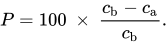
Let, as in the earlier example, the concentration of some contaminant be 580 ppm before and 0.725 ppm after treatment. Then

So this is (better than) a 99% reduction, but not yet quite a 99.9% reduction.
The following table summarizes the most common cases.
Log reduction Percentage 1-log reduction 90% 2-log reduction 99% 3-log reduction 99.9% 4-log reduction 99.99% 5-log reduction 99.999%
In general, if R is a whole number, an R-log reduction corresponds to a percentage reduction with R leading digits "9" in the percentage (provided that it is at least 10%).
Sources and credits
This article is adapted from the Wikipedia article “Log reduction”, written by its contributors and licensed under CC BY-SA 4.0. Fathomly has changed the layout, removed citation markers, navigation and maintenance notices, and adjusted punctuation. This adapted version is shared under the same license. For references, see the original article.
Fathomly is not affiliated with or endorsed by the Wikimedia Foundation. Spotted a problem? Tell us.