Local system
Locally constant sheaf of abelian groups on topological space
In mathematics, a local system (or a system of local coefficients) on a topological space X is a tool from algebraic topology which interpolates between cohomology with coefficients in a fixed abelian group A, and general sheaf cohomology in which coefficients vary from point to point. Local coefficient systems were introduced by Norman Steenrod in 1943.
Local systems are the building blocks of more general tools, such as constructible and perverse sheaves.
01Definition
Let X be a topological space. A local system (of abelian groups/modules...) on X is a locally constant sheaf (of abelian groups/of modules...) on X. In other words, a sheaf 


Locally constant sheaf
In algebraic topology, a locally constant sheaf on a topological space X is a sheaf 

A basic example is the orientation sheaf on a manifold since each point of the manifold admits an orientable open neighborhood (while the manifold itself may not be orientable).
For another example, let 


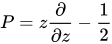

If ![p:[0,1]\to X](https://wikimedia.org/api/rest_v1/media/math/render/svg/b6b80282e47ebd79e3d481bb8338a956446ce551)
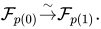

where 


If X is locally connected, the adjunction between the category of presheaves and bundles restricts to an equivalence between the category of locally constant sheaves and the category of covering spaces of X.
Equivalent definitions
Path-connected spaces
If X is path-connected, a local system 
and similarly for local systems of modules. The map 
Take local system 
![[0,1]](https://wikimedia.org/api/rest_v1/media/math/render/svg/738f7d23bb2d9642bab520020873cccbef49768d)

![(\gamma ^{*}{\mathcal {L}})_{0}\simeq \Gamma ([0,1],{\mathcal {L}})\simeq (\gamma ^{*}{\mathcal {L}})_{1}](https://wikimedia.org/api/rest_v1/media/math/render/svg/d937accea0b2b248b58eb03e6514bc278e23d25d)




where 
This shows that (for X path-connected) a local system is precisely a sheaf whose pullback to the universal cover of X is a constant sheaf.
This correspondence can be upgraded to an equivalence of categories between the category of local systems of abelian groups on X and the category of abelian groups endowed with an action of 
![\mathbb {Z} [\pi _{1}(X,x)]](https://wikimedia.org/api/rest_v1/media/math/render/svg/d6e2c7d314b753e6f1cf4efcda178fe83ca2943d)
Stronger definition on non-connected spaces
A stronger nonequivalent definition that works for non-connected X is the following: a local system is a covariant functor

from the fundamental groupoid of 






02Examples
- Constant sheaves such as
. This is a useful tool for computing cohomology since in good situations, there is an isomorphism between sheaf cohomology and singular cohomology:

- Let
. Since
, there is an
family of local systems on X corresponding to the maps
:

- Horizontal sections of vector bundles with a flat connection. If
is a vector bundle with flat connection
, then there is a local system given by
For instance, take
and
, the trivial bundle. Sections of E are n-tuples of functions on X, so
defines a flat connection on E, as does
for any matrix of one-forms
on X. The horizontal sections are then

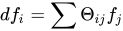
If 



- An n-sheeted covering map
is a local system with fibers given by the set
. Similarly, a fibre bundle with discrete fibre is a local system, because each path lifts uniquely to a given lift of its basepoint. (The definition adjusts to include set-valued local systems in the obvious way).
- A local system of k-vector spaces on X is equivalent to a k-linear representation of
- If X is a variety, local systems are the same thing as D-modules which are additionally coherent O_X-modules (see O modules).
- If the connection is not flat (i.e. its curvature is nonzero), then parallel transport of a fibre F_x over x around a contractible loop based at x_0 may give a nontrivial automorphism of F_x, so locally constant sheaves can not necessarily be defined for non-flat connections.
- The Gauss-Manin connection is a prominent example of a connection whose horizontal sections are studied in relation to variation of Hodge structures.
03Cohomology
There are several ways to define the cohomology of a local system, called cohomology with local coefficients, which become equivalent under mild assumptions on X.
- Given a locally constant sheaf
with coefficients in
- Given a locally constant sheaf
be the group of all functions f which map each singular n-simplex
to a global section
of the inverse-image sheaf
. These groups can be made into a cochain complex with differentials constructed as in usual singular cohomology. Define
to be the cohomology of this complex.
- The group
of singular n-chains on the universal cover of X has an action of
takes a singular n-simplex
to
. Then, given an abelian group L equipped with an action of
of
to be the cohomology of this complex.
If X is paracompact and locally contractible, then 


04Generalization
Local systems have a mild generalization to constructible sheaves -- a constructible sheaf on a locally path connected topological space

where 

![f:X={\text{Proj}}\left({\frac {\mathbb {C} [s,t][x,y,z]}{(st\cdot h(x,y,z))}}\right)\to {\text{Spec}}(\mathbb {C} [s,t])](https://wikimedia.org/api/rest_v1/media/math/render/svg/17e09022a9f3597d0f12e9478ad541755ffe42fd)
then the fibers over
are the plane curve given by 


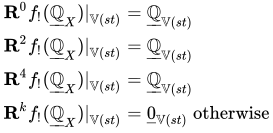
while over 
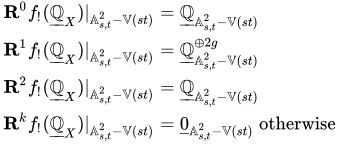
where 

05Applications
The cohomology with local coefficients in the module corresponding to the orientation covering can be used to formulate Poincaré duality for non-orientable manifolds: see Twisted Poincaré duality.
Sources and credits
This article is adapted from the Wikipedia article “Local system”, written by its contributors and licensed under CC BY-SA 4.0. Fathomly has changed the layout, removed citation markers, navigation and maintenance notices, and adjusted punctuation. This adapted version is shared under the same license. For references, see the original article.
Fathomly is not affiliated with or endorsed by the Wikimedia Foundation. Spotted a problem? Tell us.