Line-sphere intersection
Geometrical problem

In analytic geometry, a line and a sphere can intersect in three ways:
- no intersection at all,
- intersection at exactly one point, and
- intersection at two points.
Methods for distinguishing these cases, and determining the coordinates for the points in the latter cases, are useful in a number of circumstances. For example, it is a common calculation to perform during ray tracing.
01Calculation using vectors in 3D
In vector notation, the equations are as follows:
Equation for a sphere
: points on the sphere
: center point
: radius of the sphere
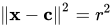
Equation for a line starting at
: origin of the line
: distance from the origin of the line
: direction of line (a non-zero vector)

Searching for points that are on the line and on the sphere means combining the equations and solving for
- Equations combined
- Expanded and rearranged:
- The form of a quadratic formula is now observable. (This quadratic equation is an instance of Joachimsthal's equation.)
- where
- Simplified
- Note that in the specific case where
, we can simplify this further to (writing
instead of

![d^{2}(\mathbf {u} \cdot \mathbf {u} )+2d[\mathbf {u} \cdot (\mathbf {o} -\mathbf {c} )]+(\mathbf {o} -\mathbf {c} )\cdot (\mathbf {o} -\mathbf {c} )-r^{2}=0](https://wikimedia.org/api/rest_v1/media/math/render/svg/63f56f594183c77e637ac6a02272408f56288ca0)


![b=2[\mathbf {u} \cdot (\mathbf {o} -\mathbf {c} )]](https://wikimedia.org/api/rest_v1/media/math/render/svg/1d92287b4c21fb5829a729083d709e52a9d5b205)

![d={\frac {-2[\mathbf {u} \cdot (\mathbf {o} -\mathbf {c} )]\pm {\sqrt {(2[\mathbf {u} \cdot (\mathbf {o} -\mathbf {c} )])^{2}-4\left\Vert \mathbf {u} \right\Vert ^{2}(\left\Vert \mathbf {o} -\mathbf {c} \right\Vert ^{2}-r^{2})}}}{2\left\Vert \mathbf {u} \right\Vert ^{2}}}](https://wikimedia.org/api/rest_v1/media/math/render/svg/9d748337376e0a0e4d6e969b1effa417430f5c31)
![\nabla =[{\hat {\mathbf {u} }}\cdot (\mathbf {o} -\mathbf {c} )]^{2}-(\left\Vert \mathbf {o} -\mathbf {c} \right\Vert ^{2}-r^{2})](https://wikimedia.org/api/rest_v1/media/math/render/svg/a592c28c9ce24edcc97e73a3965633adcee38025)
![d=-[{\hat {\mathbf {u} }}\cdot (\mathbf {o} -\mathbf {c} )]\pm {\sqrt {\nabla }}](https://wikimedia.org/api/rest_v1/media/math/render/svg/7480cf22d28504097ca4a193c0f7010082b34735)
- If
, then it is clear that no solutions exist, i.e. the line does not intersect the sphere (case 1).
- If
, then exactly one solution exists, i.e. the line just touches the sphere in one point (case 2).
- If
, two solutions exist, and thus the line touches the sphere in two points (case 3).
- If
Sources and credits
This article is adapted from the Wikipedia article “Line-sphere intersection”, written by its contributors and licensed under CC BY-SA 4.0. Fathomly has changed the layout, removed citation markers, navigation and maintenance notices, and adjusted punctuation. This adapted version is shared under the same license. For references, see the original article.
Images, from Wikimedia Commons:
- Line-Sphere Intersection Cropped.png by By Richard Wheeler (Zephyris) 2006., CC BY-SA 3.0
Fathomly is not affiliated with or endorsed by the Wikimedia Foundation. Spotted a problem? Tell us.

