Hartman-Grobman theorem
Theorem in dynamical system mathematics
In mathematics, in the study of dynamical systems, the Hartman-Grobman theorem or linearization theorem is a theorem about the local behaviour of dynamical systems in the neighbourhood of a hyperbolic equilibrium point. It asserts that linearization, a natural simplification of the system, is effective in predicting qualitative patterns of behaviour. The theorem owes its name to Philip Hartman and David M. Grobman.
The theorem states that the behaviour of a dynamical system in a domain near a hyperbolic equilibrium point is qualitatively the same as the behaviour of its linearization near this equilibrium point, where hyperbolicity means that no eigenvalue of the linearization has real part equal to zero. Therefore, when dealing with such dynamical systems one can use the simpler linearization of the system to analyse its behaviour around equilibria.
01Main theorem
Consider a system evolving in time with state 
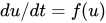


![A=[\partial f_{i}/\partial x_{j}]](https://wikimedia.org/api/rest_v1/media/math/render/svg/288a5d9930c1f7bcf051bdd447be88c932b9f905)


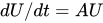
A mere topological conjugacy does not provide geometric information about the behavior near the equilibrium. Indeed, neighborhoods of any two equilibria are topologically conjugate so long as the dimensions of the contracting directions (negative eigenvalues) match and the dimensions of the expanding directions (positive eigenvalues) match. But the topological conjugacy in this context does provide the full geometric picture. In effect, the nonlinear phase portrait near the equilibrium is a thumbnail of the phase portrait of the linearized system. This is the meaning of the following regularity results, and it is illustrated by the saddle equilibrium in the example below.
Even for infinitely differentiable maps 

The Hartman-Grobman theorem has been extended to infinite-dimensional Banach spaces, non-autonomous systems 
02Example
The algebra necessary for this example is easily carried out by a web service that computes normal form coordinate transforms of systems of differential equations, autonomous or non-autonomous, deterministic or stochastic.
Consider the 2D system in variables 

By direct computation it can be seen that the only equilibrium of this system lies at the origin, that is 


![{\begin{aligned}y&\approx Y+YZ+{\tfrac {1}{42}}Y^{3}+{\tfrac {1}{2}}YZ^{2}\\[5pt]z&\approx Z-{\tfrac {1}{7}}Y^{2}-{\tfrac {1}{3}}Y^{2}Z\end{aligned}}](https://wikimedia.org/api/rest_v1/media/math/render/svg/a7aab347ae9f25e295ef6a435061ab6a404d91db)
is a smooth map between the original

That is, a distorted version of the linearization gives the original dynamics in some finite neighbourhood.
Sources and credits
This article is adapted from the Wikipedia article “Hartman-Grobman theorem”, written by its contributors and licensed under CC BY-SA 4.0. Fathomly has changed the layout, removed citation markers, navigation and maintenance notices, and adjusted punctuation. This adapted version is shared under the same license. For references, see the original article.
Fathomly is not affiliated with or endorsed by the Wikimedia Foundation. Spotted a problem? Tell us.
