Linearised polynomial
In mathematics, a linearised polynomial (or q-polynomial) is a polynomial for which the exponents of all the constituent monomials are powers of q and the coefficients come from some extension field of the finite field of order q.
We write a typical example as
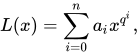



This special class of polynomials is important from both a theoretical and an applications viewpoint. The highly structured nature of their roots makes these roots easy to determine.
01Properties
- The map x ↦ L(x) is a linear map over any field containing Fq.
- The set of roots of L is an Fq-vector space and is closed under the q-Frobenius map.
- Conversely, if U is any Fq-linear subspace of some finite field containing Fq, then the polynomial that vanishes exactly on U is a linearised polynomial.
- The set of linearised polynomials over a given field is closed under addition and composition of polynomials.
- If L is a nonzero linearised polynomial over
with all of its roots lying in the field
an extension field of
02Symbolic multiplication
In general, the product of two linearised polynomials will not be a linearized polynomial, but since the composition of two linearised polynomials results in a linearised polynomial, composition may be used as a replacement for multiplication and, for this reason, composition is often called symbolic multiplication in this setting. Notationally, if L1(x) and L2(x) are linearised polynomials we define 
03Associated polynomials
The polynomials L(x) and 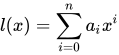
04q-polynomials over Fq
Linearised polynomials with coefficients in Fq have additional properties which make it possible to define symbolic division, symbolic reducibility and symbolic factorization. Two important examples of this type of linearised polynomial are the Frobenius automorphism 

In this special case it can be shown that, as an operation, symbolic multiplication is commutative, associative and distributes over ordinary addition. Also, in this special case, we can define the operation of symbolic division. If L(x) and L1(x) are linearised polynomials over Fq, we say that L1(x) symbolically divides L(x) if there exists a linearised polynomial L2(x) over Fq for which:

If L1(x) and L2(x) are linearised polynomials over Fq with conventional q-associates l1(x) and l2(x) respectively, then L1(x) symbolically divides L2(x) if and only if l1(x) divides l2(x). Furthermore, L1(x) divides L2(x) in the ordinary sense in this case.
A linearised polynomial L(x) over Fq of degree > 1 is symbolically irreducible over Fq if the only symbolic decompositions

Every q-polynomial L(x) over Fq of degree > 1 has a symbolic factorization into symbolically irreducible polynomials over Fq and this factorization is essentially unique (up to rearranging factors and multiplying by nonzero elements of Fq.)
For example, consider the 2-polynomial L(x) = x16 + x8 + x2 + x over F2 and its conventional 2-associate l(x) = x4 + x3 + x + 1. The factorization into irreducibles of l(x) = (x2 + x + 1)(x + 1)2 in F2[x], gives the symbolic factorization

05Affine polynomials
Let L be a linearised polynomial over 
Theorem: If A is a nonzero affine polynomial over
Sources and credits
This article is adapted from the Wikipedia article “Linearised polynomial”, written by its contributors and licensed under CC BY-SA 4.0. Fathomly has changed the layout, removed citation markers, navigation and maintenance notices, and adjusted punctuation. This adapted version is shared under the same license. For references, see the original article.
Fathomly is not affiliated with or endorsed by the Wikimedia Foundation. Spotted a problem? Tell us.