Linear separability
Geometric property of a pair of sets of points in Euclidean geometry

In Euclidean geometry, linear separability is a property of two sets of points. This is most easily visualized in two dimensions (the Euclidean plane) by thinking of one set of points as being colored blue and the other set of points as being colored red. These two sets are linearly separable if there exists at least one line in the plane with all of the blue points on one side of the line and all the red points on the other side. This idea immediately generalizes to higher-dimensional Euclidean spaces if the line is replaced by a hyperplane.
The problem of determining if a pair of sets is linearly separable and finding a separating hyperplane if they are, arises in several areas. In statistics and machine learning, classifying certain types of data is a problem for which good algorithms exist that are based on this concept.
01Mathematical definition
Let 


The separating hyperplane is composed of points 


Equivalently, two sets are linearly separable precisely when their respective convex hulls are disjoint (colloquially, do not overlap).

02Examples
Three non-collinear points in two classes ('+' and '-') are always linearly separable in two dimensions. This is illustrated by the three examples in the following figure (the all '+' case is not shown, but is similar to the all '-' case):
However, not all sets of four points, no three collinear, are linearly separable in two dimensions. The following example would need two straight lines and thus is not linearly separable:
Notice that three points which are collinear and of the form "+ ⋅⋅⋅ , ⋅⋅⋅ +" are also not linearly separable.
03Number of linear separations
Let 
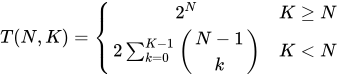
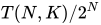


04Linear separability of Boolean functions in n variables
A Boolean function in n variables can be thought of as an assignment of 0 or 1 to each vertex of a Boolean hypercube in n dimensions. This gives a natural division of the vertices into two sets. The Boolean function is said to be linearly separable provided these two sets of points are linearly separable. The number of distinct Boolean functions is 
Such functions are also called linear threshold logic, or perceptrons. The classical theory is summarized in, as Knuth claims.
The number of Boolean functions which are linearly separable is only known exactly up to the 

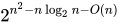
It is co-NP-complete to decide whether a Boolean function given in disjunctive or conjunctive normal form is linearly separable.
| Number of variables | Boolean functions | Linearly separable Boolean functions |
|---|---|---|
| 2 | 16 | 14 |
| 3 | 256 | 104 |
| 4 | 65536 | 1882 |
| 5 | 4294967296 | 94572 |
| 6 | 18446744073709552000 | 15028134 |
| 7 | 3.402823669 ×10^38 | 8378070864 |
| 8 | 1.157920892 ×10^77 | 17561539552946 |
| 9 | 1.340780792 ×10^154 | 144130531453121108 |
05Threshold logic
A linear threshold logic gate is a Boolean function defined by 


For any fixed 


06Support vector machines
Classifying data is a common task in machine learning. Suppose some data points, each belonging to one of two sets, are given and we wish to create a model that will decide which set a new data point will be in. In the case of support vector machines, a data point is viewed as a p-dimensional vector (a list of p numbers), and we want to know whether we can separate such points with a (p − 1)-dimensional hyperplane. This is called a linear classifier. There are many hyperplanes that might classify (separate) the data. One reasonable choice as the best hyperplane is the one that represents the largest separation, or margin, between the two sets. So we choose the hyperplane so that the distance from it to the nearest data point on each side is maximized. If such a hyperplane exists, it is known as the maximum-margin hyperplane and the linear classifier it defines is known as a maximum margin classifier.
More formally, given some training data 

where the yi is either 1 or −1, indicating the set to which the point 



where 


If the training data are linearly separable, we can select two hyperplanes in such a way that they separate the data and there are no points between them, and then try to maximize their distance.
Sources and credits
This article is adapted from the Wikipedia article “Linear separability”, written by its contributors and licensed under CC BY-SA 4.0. Fathomly has changed the layout, removed citation markers, navigation and maintenance notices, and adjusted punctuation. This adapted version is shared under the same license. For references, see the original article.
Images, from Wikimedia Commons:
- Linearly separable red-blue cropped .svg by Krb19, CC BY-SA 4.0
- Svm separating hyperplanes (SVG).svg by User:ZackWeinberg, based on PNG version by User:Cyc, CC BY-SA 3.0
Fathomly is not affiliated with or endorsed by the Wikimedia Foundation. Spotted a problem? Tell us.

