Line of action
Geometric representation of a force on an object

In physics, the line of action (also called line of application) of a force (F→) is a geometric representation of how the force is applied. It is the straight line through the point at which the force is applied, and is in the same direction as the vector F→. The lever arm is the perpendicular distance from the axis of rotation to the line of action.
The concept is essential, for instance, for understanding the net effect of multiple forces applied to a body. For example, if two forces of equal magnitude act upon a rigid body along the same line of action but in opposite directions, they cancel and have no net effect. But if, instead, their lines of action are not identical, but merely parallel, then their effect is to create a moment on the body, which tends to rotate it.
01Calculation of torque
For the simple geometry associated with the figure, there are three equivalent equations for the magnitude of the torque associated with a force 

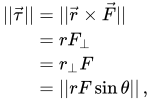
where 


Sources and credits
This article is adapted from the Wikipedia article “Line of action”, written by its contributors and licensed under CC BY-SA 4.0. Fathomly has changed the layout, removed citation markers, navigation and maintenance notices, and adjusted punctuation. This adapted version is shared under the same license. For references, see the original article.
Images, from Wikimedia Commons:
- Torque lever arm w point of application and line of action.svg by Guy vandegrift, CC BY-SA 4.0
Fathomly is not affiliated with or endorsed by the Wikimedia Foundation. Spotted a problem? Tell us.