Length function
Function in geometric group theory
In the mathematical field of geometric group theory, a length function is a function that assigns a number to each element of a group.
01Definition
A length function L : G → R+ on a group G is a function satisfying:
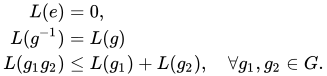
Compare with the axioms for a metric and a filtered algebra.
02Word metric
An important example of a length is the word metric: given a presentation of a group by generators and relations, the length of an element is the length of the shortest word expressing it.
Coxeter groups (including the symmetric group) have combinatorially important length functions, using the simple reflections as generators (thus each simple reflection has length 1). See also: length of a Weyl group element.
A longest element of a Coxeter group is both important and unique up to conjugation (up to different choice of simple reflections).
03Properties
A group with a length function does not form a filtered group, meaning that the sublevel sets 
However, the group algebra of a group with a length functions forms a filtered algebra: the axiom 
Sources and credits
This article is adapted from the Wikipedia article “Length function”, written by its contributors and licensed under CC BY-SA 4.0. Fathomly has changed the layout, removed citation markers, navigation and maintenance notices, and adjusted punctuation. This adapted version is shared under the same license. For references, see the original article.
Fathomly is not affiliated with or endorsed by the Wikimedia Foundation. Spotted a problem? Tell us.