Left recursion
Theory of computer sciences
In the formal language theory of computer science, left recursion is a special case of recursion where a string is recognized as part of a language by the fact that it decomposes into a string from that same language (on the left) and a suffix (on the right). For instance, 


In terms of context-free grammar, a nonterminal is left-recursive if the leftmost symbol in one of its productions is itself (in the case of direct left recursion) or can be made itself by some sequence of substitutions (in the case of indirect left recursion).
01Definition
A grammar is left-recursive if and only if there exists a nonterminal symbol 
,
where 

Direct left recursion
Direct left recursion occurs when the definition can be satisfied with only one substitution. It requires a rule of the form

where

is directly left-recursive. A left-to-right recursive descent parser for this rule might look like
void Expression() { Expression(); match('+'); Term(); }and such code would fall into infinite recursion when executed.
Indirect left recursion
Indirect left recursion occurs when the definition of left recursion is satisfied via several substitutions. It entails a set of rules following the pattern




where 


then gives 
02Uses
Left recursion is commonly used as an idiom for making operations left-associative: that an expression a+b-c-d+e is evaluated as (((a+b)-c)-d)+e. In this case, that evaluation order could be achieved as a matter of syntax via the three grammatical rules


These only allow parsing the 

03Removing left recursion
Left recursion often poses problems for parsers, either because it leads them into infinite recursion (as in the case of most top-down parsers) or because they expect rules in a normal form that forbids it (as in the case of many bottom-up parsers). Therefore, a grammar is often preprocessed to eliminate the left recursion.
Removing direct left recursion
The general algorithm to remove direct left recursion follows. Several improvements to this method have been made.
For a left-recursive nonterminal 

where:
- each
- each
is a sequence of nonterminals and terminals that does not start with
Replace these with two sets of productions, one set for

and another set for the fresh nonterminal 

Repeat this process until no direct left recursion remains.
As an example, consider the rule set

This could be rewritten to avoid left recursion as


Removing all left recursion
The above process can be extended to eliminate all left recursion, by first converting indirect left recursion to direct left recursion on the highest numbered nonterminal in a cycle.
- Inputs A grammar: a set of nonterminals
and their productions
- Output A modified grammar generating the same language but without left recursion
- For each nonterminal
:
- Repeat until an iteration leaves the grammar unchanged:
- For each rule
, the
being a sequence of terminals and nonterminals:
- If
and
:
- Let
be
- Remove the rule
- For each rule
:
- Add the rule
.
- Add the rule
- Let
- If
- For each rule
- Remove direct left recursion for
- Repeat until an iteration leaves the grammar unchanged:
- For each nonterminal
Step 1.1.1 amounts to expanding the initial nonterminal 
The algorithm may be viewed as establishing a topological ordering on nonterminals: afterwards there can only be a rule 

04Pitfalls
Although the above transformations preserve the language generated by a grammar, they may change the parse trees that witness strings' recognition. With suitable bookkeeping, tree rewriting can recover the originals, but if this step is omitted, the differences may change the semantics of a parse.
Associativity is particularly vulnerable; left-associative operators typically appear in right-associative-like arrangements under the new grammar. For example, starting with this grammar:



the standard transformations to remove left recursion yield the following:




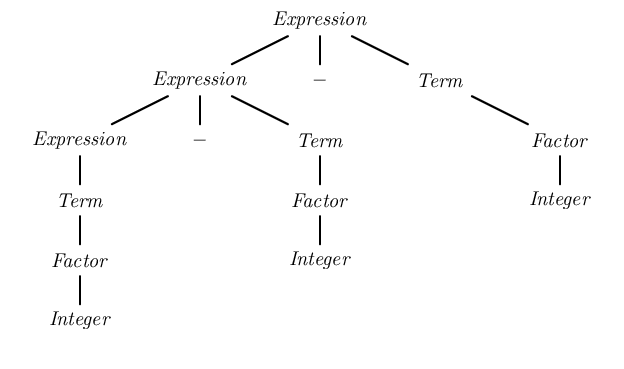
Parsing the string "1 - 2 - 3" with the first grammar in an LALR parser (which can handle left-recursive grammars) would have resulted in the parse tree:
This parse tree groups the terms on the left, giving the correct semantics (1 - 2) - 3.
Parsing with the second grammar gives
which, properly interpreted, signifies 1 + (-2 + (-3)), also correct, but less faithful to the input and much harder to implement for some operators. Notice how terms to the right appear deeper in the tree, much as a right-recursive grammar would arrange them for 1 - (2 - 3).
05Accommodating left recursion in top-down parsing
A formal grammar that contains left recursion cannot be parsed by a LL(k)-parser or other naive recursive descent parser unless it is converted to a weakly equivalent right-recursive form. In contrast, left recursion is preferred for LALR parsers because it results in lower stack usage than right recursion. However, more sophisticated top-down parsers can implement general context-free grammars by use of curtailment. In 2006, Frost and Hafiz described an algorithm which accommodates ambiguous grammars with direct left-recursive production rules. That algorithm was extended to a complete parsing algorithm to accommodate indirect as well as direct left recursion in polynomial time, and to generate compact polynomial-size representations of the potentially exponential number of parse trees for highly ambiguous grammars by Frost, Hafiz and Callaghan in 2007. The authors then implemented the algorithm as a set of parser combinators written in the Haskell programming language.
Sources and credits
This article is adapted from the Wikipedia article “Left recursion”, written by its contributors and licensed under CC BY-SA 4.0. Fathomly has changed the layout, removed citation markers, navigation and maintenance notices, and adjusted punctuation. This adapted version is shared under the same license. For references, see the original article.
Images, from Wikimedia Commons:
- Left-recursive-parse-of-a-double-subtraction.png by Maria Law, Public domain
- Right-recursive-parse-of-a-double-subtraction.png by Maria Law, Public domain
Fathomly is not affiliated with or endorsed by the Wikimedia Foundation. Spotted a problem? Tell us.