Reference articles on history, science, culture and more
Encyclopedia

Lanczos tensor

Rank-3 tensor in general relativity associated with gauge fields

The Lanczos tensor or Lanczos potential is a rank 3 tensor in general relativity that generates the Weyl tensor. It was first introduced by Cornelius Lanczos in 1949. The theoretical importance of the Lanczos tensor is that it serves as the gauge field for the gravitational field in the same way that, by analogy, the electromagnetic four-potential generates the electromagnetic field.

01Definition

The Lanczos tensor can be defined in a few different ways. The most common modern definition is through the Weyl-Lanczos equations, which demonstrate the generation of the Weyl tensor from the Lanczos tensor. These equations, presented below, were given by Takeno in 1964. The way that Lanczos introduced the tensor originally was as a Lagrange multiplier on constraint terms studied in the variational approach to general relativity. Under any definition, the Lanczos tensor H exhibits the following symmetries:


H_{abc}+H_{bac}=0,\,
H_{abc}+H_{bca}+H_{cab}=0.

The Lanczos tensor always exists in four dimensions but does not generalize to higher dimensions. This highlights the specialness of four dimensions. Note further that the full Riemann tensor cannot in general be derived from derivatives of the Lanczos potential alone. The Einstein field equations must provide the Ricci tensor to complete the components of the Ricci decomposition.

The Curtright field has a gauge-transformation dynamics similar to that of Lanczos tensor. But Curtright field exists in arbitrary dimensions > 4D.

Weyl-Lanczos equations

The Weyl-Lanczos equations express the Weyl tensor entirely as derivatives of the Lanczos tensor:

{\begin{aligned}C_{abcd}&=H_{abc;d}+H_{cda;b}+H_{bad;c}+H_{dcb;a}+(H^{e}{}_{(ac);e}+H_{(a|e|}{}^{e}{}_{;c)})g_{bd}+(H^{e}{}_{(bd);e}+H_{(b|e|}{}^{e}{}_{;d)})g_{ac}\\&\quad -(H^{e}{}_{(ad);e}+H_{(a|e|}{}^{e}{}_{;d)})g_{bc}-(H^{e}{}_{(bc);e}+H_{(b|e|}{}^{e}{}_{;c)})g_{ad}-{\frac {2}{3}}H^{ef}{}_{f;e}(g_{ac}g_{bd}-g_{ad}g_{bc})\end{aligned}}

where C_{abcd} is the Weyl tensor, the semicolon denotes the covariant derivative, and the subscripted parentheses indicate symmetrization. Although the above equations can be used to define the Lanczos tensor, they also show that it is not unique but rather has gauge freedom under an affine group. If \Phi ^{a} is an arbitrary vector field, then the Weyl-Lanczos equations are invariant under the gauge transformation

H'_{abc}=H_{abc}+\Phi _{[a}g_{b]c}

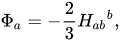
where the subscripted brackets indicate antisymmetrization. An often convenient choice is the Lanczos algebraic gauge, \Phi _{a}=-{\frac {2}{3}}H_{ab}{}^{b}, which sets H'_{ab}{}^{b}=0. The gauge can be further restricted through the Lanczos differential gauge H_{ab}{}^{c}{}_{;c}=0. These gauge choices reduce the Weyl-Lanczos equations to the simpler form
C_{abcd}=H_{abc;d}+H_{cda;b}+H_{bad;c}+H_{dcb;a}+H^{e}{}_{ac;e}g_{bd}+H^{e}{}_{bd;e}g_{ac}-H^{e}{}_{ad;e}g_{bc}-H^{e}{}_{bc;e}g_{ad}.

02Wave equation

The Lanczos potential tensor satisfies a wave equation
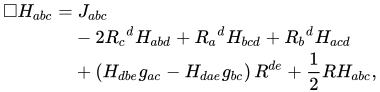
{\begin{aligned}\Box H_{abc}=&\;J_{abc}\\&{}-2{R_{c}}^{d}H_{abd}+{R_{a}}^{d}H_{bcd}+{R_{b}}^{d}H_{acd}\\&{}+\left(H_{dbe}g_{ac}-H_{dae}g_{bc}\right)R^{de}+{\frac {1}{2}}RH_{abc},\end{aligned}}

where \Box is the d'Alembert operator and

J_{abc}=R_{ca;b}-R_{cb;a}-{\frac {1}{6}}\left(g_{ca}R_{;b}-g_{cb}R_{;a}\right)

is known as the Cotton tensor. Since the Cotton tensor depends only on covariant derivatives of the Ricci tensor, it can perhaps be interpreted as a kind of matter current. The additional self-coupling terms have no direct electromagnetic equivalent. These self-coupling terms, however, do not affect the vacuum solutions, where the Ricci tensor vanishes and the curvature is described entirely by the Weyl tensor. Thus in vacuum, the Einstein field equations are equivalent to the homogeneous wave equation \Box H_{abc}=0, in perfect analogy to the vacuum wave equation \Box A_{a}=0 of the electromagnetic four-potential. This shows a formal similarity between gravitational waves and electromagnetic waves, with the Lanczos tensor well-suited for studying gravitational waves.

In the weak field approximation where g_{ab}=\eta _{ab}+h_{ab}, a convenient form for the Lanczos tensor in the Lanczos gauge is

4H_{abc}\approx h_{ac,b}-h_{bc,a}-{\frac {1}{6}}(\eta _{ac}{h^{d}}_{d,b}-\eta _{bc}{h^{d}}_{d,a}).

03Example

The most basic nontrivial case for expressing the Lanczos tensor is, of course, for the Schwarzschild metric. The simplest, explicit component representation in natural units for the Lanczos tensor in this case is

H_{trt}={\frac {GM}{r^{2}}}

with all other components vanishing up to symmetries. This form, however, is not in the Lanczos gauge. The nonvanishing terms of the Lanczos tensor in the Lanczos gauge are
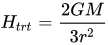
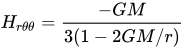
H_{trt}={\frac {2GM}{3r^{2}}}
H_{r\theta \theta }={\frac {-GM}{3(1-2GM/r)}}
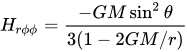
H_{r\phi \phi }={\frac {-GM\sin ^{2}\theta }{3(1-2GM/r)}}

It is further possible to show, even in this simple case, that the Lanczos tensor cannot in general be reduced to a linear combination of the spin coefficients of the Newman-Penrose formalism, which attests to the Lanczos tensor's fundamental nature. Similar calculations have been used to construct arbitrary Petrov type D solutions.

Watch videos about Lanczos tensorExplainers and documentaries on YouTube (opens in a new tab)

Sources and credits

This article is adapted from the Wikipedia article Lanczos tensor, written by its contributors and licensed under CC BY-SA 4.0. Fathomly has changed the layout, removed citation markers, navigation and maintenance notices, and adjusted punctuation. This adapted version is shared under the same license. For references, see the original article.

Fathomly is not affiliated with or endorsed by the Wikimedia Foundation. Spotted a problem? Tell us.

Continue exploring

Related topics

Bach tensor

In differential geometry and general relativity, the Bach tensor is a trace-free tensor of rank 2 which is conformally invariant in dimension n = 4. Before 1968, it was the only known conformally invariant tensor that is algebraically independent of the Weyl tensor.

Bel-Robinson tensor

In general relativity and differential geometry, the Bel-Robinson tensor is a tensor defined in the abstract index notation by: T a b c d = C a e c f C b e d f + 1 4 ϵ a e h i ϵ b e j k C h i c f C j k d f {\displaystyle T_{abcd}=C_{aecf}C_{b}{}^{e}{}_{d}{}^{f}+{\frac {1}{4}}\epsilon _{ae}{}^{hi}\epsilon _{b}{}^{ej}{}_{k}C_{hicf}C_{j}{}^{k}{}_{d}{}^{f}} Alternatively, T a b c d = C a e c f C b e d f − 3 2 g a [ b C j k ] c f C j k d f {\displaystyle T_{abcd}=C_{aecf}C_{b}{}^{e}{}_{d}{}^{f}-{\frac {3}{2}}g_{a[b}C_{jk]cf}C^{jk}{}_{d}{}^{f}} where C a b c d {\displaystyle C_{abcd}} is the Weyl tensor. It was introduced by Lluís Bel in 1959.

Schouten tensor

In Riemannian geometry the Schouten tensor is a second-order tensor introduced by Jan Arnoldus Schouten defined for n ≥ 3 by: P = 1 n − 2 g ) ⇔ R i c = ( n − 2 ) P + J g , {\displaystyle P={\frac {1}{n-2}}\left(\mathrm {Ric} -{\frac {R}{2(n-1)}}g\right)\,\Leftrightarrow \mathrm {Ric} =(n-2)P+Jg\,,} where Ric is the Ricci tensor (defined by contracting the first and third indices of the Riemann tensor), R is the scalar curvature, g is the Riemannian metric, J = 1 2 ( n − 1 ) R {\displaystyle J={\frac {1}{2(n-1)}}R} is the trace of P and n is the dimension of the manifold. The Weyl tensor equals the Riemann curvature tensor minus the Kulkarni-Nomizu product of the Schouten tensor with the metric.