Ladder operator
Raising and lowering operators in quantum mechanics
In linear algebra (and its application to quantum mechanics), a raising or lowering operator (collectively known as ladder operators) is an operator that increases or decreases the eigenvalue of another operator. In quantum mechanics, the raising and lowering operators are commonly known as the creation and annihilation operators, respectively. Well-known applications of ladder operators in quantum mechanics are in the formalisms of the quantum harmonic oscillator and angular momentum.
01Terminology
There is a relationship between the raising and lowering ladder operators and the creation and annihilation operators commonly used in quantum field theory which lies in representation theory. The creation operator ai† increments the number of particles in state i, while the corresponding annihilation operator ai decrements the number of particles in state i. This clearly satisfies the requirements of the above definition of a ladder operator: the incrementing or decrementing of the eigenvalue of another operator (in this case the particle number operator).
Confusion arises because the term ladder operator is typically used to describe an operator that acts to increment or decrement a quantum number describing the state of a system. To change the state of a particle with the creation/annihilation operators of QFT requires the use of both annihilation and creation operators. An annihilation operator is used to remove a particle from the initial state and a creation operator is used to add a particle to the final state.
The term "ladder operator" or "raising and lowering operators" is also sometimes used in mathematics, in the context of the theory of Lie algebras and in particular the affine Lie algebras. For example, to describe the su(2) subalgebras, the root system and the highest weight modules can be constructed by means of the ladder operators. In particular, the highest weight is annihilated by the raising operators; the rest of the positive root space is obtained by repeatedly applying the lowering operators (one set of ladder operators per subalgebra).
02Motivation from mathematics
From a representation theory standpoint a linear representation of a semi-simple Lie group in continuous real parameters induces a set of generators for the Lie algebra. A complex linear combination of those are the ladder operators. For each parameter there is a set of ladder operators; these are then a standardized way to navigate one dimension of the root system and root lattice. The ladder operators of the quantum harmonic oscillator or the "number representation" of second quantization are just special cases of this fact. Ladder operators then become ubiquitous in quantum mechanics from the angular momentum operator, to coherent states and to discrete magnetic translation operators.
03General formulation
Suppose that two operators X and N have the commutation relation
![[N,X]=cX](https://wikimedia.org/api/rest_v1/media/math/render/svg/64f28c80ca3ecb2e7f1456685852aab2fcb39c42)

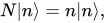

![{\begin{aligned}NX|n\rangle &=(XN+[N,X])|n\rangle \\&=XN|n\rangle +[N,X]|n\rangle \\&=Xn|n\rangle +cX|n\rangle \\&=(n+c)X|n\rangle .\end{aligned}}](https://wikimedia.org/api/rest_v1/media/math/render/svg/6eaf3806c2784f9cf5f57319df09bc3ff695e511)
In other words, if 
If N is a Hermitian operator, then c must be real, and the Hermitian adjoint of X obeys the commutation relation
![[N,X^{\dagger }]=-cX^{\dagger }.](https://wikimedia.org/api/rest_v1/media/math/render/svg/e3395ea77248bdf9d4afb58dfd5fc4b2adb3ddf4)
In particular, if X is a lowering operator for N, then X† is a raising operator for N and conversely.
04Angular momentum
A particular application of the ladder operator concept is found in the quantum-mechanical treatment of angular momentum. For a general angular momentum vector J with components Jx, Jy and Jz one defines the two ladder operators
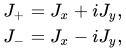
The commutation relation between the cartesian components of any angular momentum operator is given by
![[J_{i},J_{j}]=i\hbar \epsilon _{ijk}J_{k},](https://wikimedia.org/api/rest_v1/media/math/render/svg/452ea8c532b6bf78f44018b1ec58cddcb9b610e8)
From this, the commutation relations among the ladder operators and Jz are obtained:
![{\begin{aligned}{}[J_{z},J_{\pm }]&=\pm \hbar J_{\pm },\\{}[J_{+},J_{-}]&=2\hbar J_{z}\end{aligned}}](https://wikimedia.org/api/rest_v1/media/math/render/svg/7e85a610441d95fddaadaab428fd1e0b931ace5b)

The properties of the ladder operators can be determined by observing how they modify the action of the Jz operator on a given state:
![{\begin{aligned}J_{z}J_{\pm }|j\,m\rangle &={\big (}J_{\pm }J_{z}+[J_{z},J_{\pm }]{\big )}|j\,m\rangle \\&=(J_{\pm }J_{z}\pm \hbar J_{\pm })|j\,m\rangle \\&=\hbar (m\pm 1)J_{\pm }|j\,m\rangle .\end{aligned}}](https://wikimedia.org/api/rest_v1/media/math/render/svg/570e9b1203381f8a50d2d876053e4f6dd125735a)
Compare this result with

Thus, one concludes that 

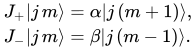
This illustrates the defining feature of ladder operators in quantum mechanics: the incrementing (or decrementing) of a quantum number, thus mapping one quantum state onto another. This is the reason that they are often known as raising and lowering operators.
To obtain the values of α and β, first take the norm of each operator, recognizing that J+ and J− are a Hermitian conjugate pair (

The product of the ladder operators can be expressed in terms of the commuting pair J2 and Jz:
![{\begin{aligned}J_{-}J_{+}&=(J_{x}-iJ_{y})(J_{x}+iJ_{y})=J_{x}^{2}+J_{y}^{2}+i[J_{x},J_{y}]=J^{2}-J_{z}^{2}-\hbar J_{z},\\J_{+}J_{-}&=(J_{x}+iJ_{y})(J_{x}-iJ_{y})=J_{x}^{2}+J_{y}^{2}-i[J_{x},J_{y}]=J^{2}-J_{z}^{2}+\hbar J_{z}.\end{aligned}}](https://wikimedia.org/api/rest_v1/media/math/render/svg/500fe8b785ae37f58fbaaedbaf48c50cf2162e72)
Thus, one may express the values of |α|2 and |β|2 in terms of the eigenvalues of J2 and Jz:

The phases of α and β are not physically significant, thus they can be chosen to be positive and real (Condon-Shortley phase convention). We then have

Confirming that m is bounded by the value of j (
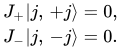
The above demonstration is effectively the construction of the Clebsch-Gordan coefficients.
Applications in atomic and molecular physics
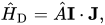
Many terms in the Hamiltonians of atomic or molecular systems involve the scalar product of angular momentum operators. An example is the magnetic dipole term in the hyperfine Hamiltonian:
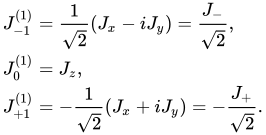
The angular momentum algebra can often be simplified by recasting it in the spherical basis. Using the notation of spherical tensor operators, the "−1", "0" and "+1" components of J(1) ≡ J are given by
From these definitions, it can be shown that the above scalar product can be expanded as

The significance of this expansion is that it clearly indicates which states are coupled by this term in the Hamiltonian, that is those with quantum numbers differing by mi = ±1 and mj = ∓1 only.
05Harmonic oscillator
Another application of the ladder operator concept is found in the quantum-mechanical treatment of the harmonic oscillator. We can define the lowering and raising operators as
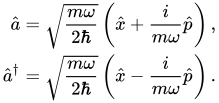
They provide a convenient means to extract energy eigenvalues without directly solving the system's differential equation.
Ladder operator applying to harmonic oscillator's energy levels:

06Hydrogen-like atom
There are two main approaches given in the literature using ladder operators, one using the Laplace-Runge-Lenz vector, another using factorization of the Hamiltonian.
Laplace-Runge-Lenz vector
Another application of the ladder operator concept is found in the quantum mechanical treatment of the electronic energy of hydrogen-like atoms and ions. The Laplace-Runge-Lenz vector commutes with the Hamiltonian for an inverse square spherically symmetric potential and can be used to determine ladder operators for this potential.
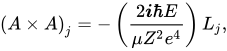
We can define the lowering and raising operators (based on the classical Laplace-Runge-Lenz vector)





The commutators needed to proceed are
![[A_{\pm },L_{z}]=\mp {\boldsymbol {i}}\hbar A_{\mp }](https://wikimedia.org/api/rest_v1/media/math/render/svg/07f0fe3a400a6139a7980d27bdcbdf0e47c526c8)
![[A_{\pm },L^{2}]=\mp 2\hbar ^{2}A_{\pm }-2\hbar A_{\pm }L_{z}\pm 2\hbar A_{z}L_{\pm }.](https://wikimedia.org/api/rest_v1/media/math/render/svg/6dc7e94cbadbf04aadec9d98d94cc13eaf47c26e)



Given the Pauli equations IV:






Factorization of the Hamiltonian
The Hamiltonian for a hydrogen-like potential can be written in spherical coordinates as
![H={\frac {1}{2\mu }}\left[p_{r}^{2}+{\frac {1}{r^{2}}}L^{2}\right]+V(r),](https://wikimedia.org/api/rest_v1/media/math/render/svg/b454f27492804a67074113ac4cbe0d2c40fd8c69)
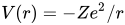

Suppose 



![H_{l}={\frac {1}{2\mu }}\left[p_{r}^{2}+{\frac {1}{r^{2}}}l(l+1)\hbar ^{2}\right]+V(r).](https://wikimedia.org/api/rest_v1/media/math/render/svg/73fa1652389d58702a4805bcef36ad34ee7cdf6c)
The factorization method was developed by Infeld and Hull for differential equations. Newmarch and Golding applied it to spherically symmetric potentials using operator notation.
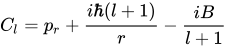
Suppose we can find a factorization of the Hamiltonian by operators 
 | 1 |
and




,](https://wikimedia.org/api/rest_v1/media/math/render/svg/3b87daf076075ae7a43f06efb24c476df0516dde)





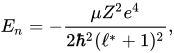
For the hydrogenic atom, setting
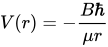

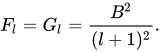
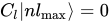



Relation to group theory
Whenever there is degeneracy in a system, there is usually a related symmetry property and group. The degeneracy of the energy levels for the same value of
073D isotropic harmonic oscillator
The 3D isotropic harmonic oscillator has a potential given by
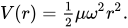
It can similarly be managed using the factorization method.
Factorization method
A suitable factorization is given by
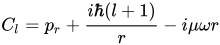



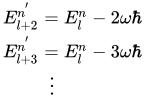






It then follows the 


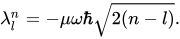
There is degeneracy caused from angular momentum; there is additional degeneracy caused by the oscillator potential.
Consider the states 




Relation to group theory
The degeneracies of the 3D isotropic harmonic oscillator are related to the special unitary group SU(3)
08History
Many sources credit Paul Dirac with the invention of ladder operators. Dirac's use of the ladder operators shows that the total angular momentum quantum number 
Sources and credits
This article is adapted from the Wikipedia article “Ladder operator”, written by its contributors and licensed under CC BY-SA 4.0. Fathomly has changed the layout, removed citation markers, navigation and maintenance notices, and adjusted punctuation. This adapted version is shared under the same license. For references, see the original article.
Fathomly is not affiliated with or endorsed by the Wikimedia Foundation. Spotted a problem? Tell us.