L-function
Meromorphic function on the complex plane

An L-function is a meromorphic function on the complex plane, and one out of several categories of mathematical objects studied in analytic number theory and related fields. L-functions share fundamental properties and characteristics with the Riemann zeta function, which serves as the prototypical example of an L-function; therefore, L-functions are generalisations of the Riemann zeta function. Some important conjectures involving L-functions are, consequently, the Riemann hypothesis and its generalisations.
A Dirichlet series, usually convergent on a half-plane, that may give rise to an L-function via analytic continuation, is called an L-series.
Fundamental subclasses of L-functions were built on the work of Leonhard Euler (which is now known as the Riemann zeta function). Most notably, the mathematicians Bernhard Riemann (1826-1866), Richard Dedekind (1831-1916), Erich Hecke (1887-1947) and Emil Artin (1898-1962) investigated the subclasses of L-functions, discovering eponymous L-functions each.
The terms "L-function" and "zeta-function" are often used synonymously due to the fundamentally similar and derivative nature of the work, however, not all zeta-functions are L-functions. Most notably, the Prime zeta function is not an L-function, since they cannot be analytically extended to the entire complex plane.
01Definition
As one might infer from the introduction, there is still no general and widely accepted definition of an L-function and its construction. Various constructions and definitions as per various prominent authors can be found as follows.
Iwaniec and Kowalski's Analytic Number Theory, 2004
This definition is abstract and incomplete in the sense that it doesn't specify the arithmetic objects to which he assigns L-functions, nor the exact mechanism of this assignment. However, it includes properties generally expected of L-functions.
The definition is extended and starts by defining 6 preliminary definitions, as follows:
Dirichlet Series and Euler Product
The arithmetic object 
,
which is also called an L-series, and an Euler product:
.
Here, 


The natural number 


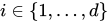

The complex numbers 

For a given 
,
that is, the 

Gamma Factor
The object
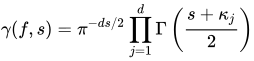
where 


Leader (Conductor)
A natural number is also assigned to the object
,
This is the so-called “leader” or “conductor” of the L-function 
Complete L-Function
Using the Dirichlet series, the gamma factor, and the leading coefficient associated with

Root
Furthermore, the object

This complex number is called the root of the L-function
Dual, Arithmetic Object
Now, the arithmetic object 
,
an Euler product

with 


If 

Conditions to satisfy
The objects mentioned above, associated with the arithmetic object
| Index | Condition | Description |
|---|---|---|
| 1 | Absolute value of local parameters for |
For every prime number and every , we have 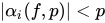 . . |
| 2 | Values of local parameters for unbranched |
For all primes that are unramified with respect to , and for all , we have  . . |
| 3 | Requirements for the local parameters at infinity | The parameters are either real or appear in the form of complex conjugate pairs in the gamma factor  . Furthermore, . Furthermore,  for every for every 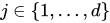 . This last condition ensures that has no zeroes in . This last condition ensures that has no zeroes in  and no poles with and no poles with  . .  denotes the real part of a complex number. denotes the real part of a complex number. |
| 4 | Absolute convergence of the Dirichlet Series and the Euler product | Both the Dirichlet series and the Euler product associated with must converge absolutely for  . . |
| 5 | Agreement between the L-function, the Dirichlet series, and the Euler product in a complex half-plane | The L-function, the Dirichlet series, and the Euler product associated with must coincide in the complex half-plane :
|
| 6 | Analytic Continuity and Pole Points | It follows from the conditions that the must satisfy that the Dirichlet series is holomorphic in the half-plane . However, this must also be analytically extendable to a meromorphic function of order 1 on the entire  , which has poles at most at , which has poles at most at  and and  . . |
| 7 | Absolute value of the root number | The root number  has the absolute value 1. Thus, has the absolute value 1. Thus,  must equal 1. must equal 1. |
| 8 | Requirements for the objects associated with the dual of |
With regard to the dual of , the following must hold:
These imply that in the Dirichlet series associated with |
| 9 | Functional equation | The two complete L-functions associated with and , respectively, satisfy the functional equation
for all |


 for all
 and
and .
. coefficients are precisely the complex conjugates of the
 .
.Iwaniec and Kowalski’s definition reflects the fact that a function that is considered an L-function typically appears as a mapping of the L-function to a mathematical object (e.g., a Dirichlet character or an algebraic number field). Their definition is abstract and incomplete, as it leaves open the question of exactly what those mathematical objects are and how that mapping is to be carried out.
Atle Selberg in the Amalfi Conference on Analytic Number Theory, 1992
The definition proposed by the Norwegian-American mathematician Atle Selberg in 1989 is independent of other mathematical objects. In a non-abstract, unambiguous definition, he specifies a subset of the set of all Dirichlet series whose elements must satisfy certain properties: absolute convergence of the Dirichlet series, analytic continuation, functional equation, Ramanujan conjecture and Euler product. This subset is today referred to as the Selberg class.
The overarching hypothesis and the motivating background for the definition of the Selberg class is the so-called Great Riemann Hypothesis. Applied to the Selberg class, this hypothesis states that no zero of an analytic continuation of a Dirichlet series in the Selberg class has a real part greater than 1/2. In the case of the (supposedly) simplest element of the Selberg class (the Riemann Dirichlet series together with its analytic continuation to the Riemann zeta function), this conjecture corresponds to the Riemann Hypothesis, which to this day has been neither proven nor disproven.
It is against this backdrop that the remaining shortcomings in the definition of the term L-function must be viewed: one would like to define the term "L-function" in such a way that L-functions verifiably satisfy the Great Riemann Hypothesis. Yet, on the other hand, one has not even been able to prove the simplest case (the Riemann Hypothesis for the Riemann zeta function), which could be a sign of a lack of understanding of the Riemann zeta function and thus makes it difficult to provide a clear definition of the generalized concept of a L-function.

02Examples
This section provides an overview of basic examples of L-functions.
Riemann Zeta Function
The simplest example of an L-function, and at the same time the fundamental basis for any definition of the term L-function based on the work of Leonhard Euler, is the Riemann zeta function 
One of the possible “arithmetic objects” 

that is

for all

Since all 


The degree of the Euler product of the Riemann zeta function is
.
For its local parameters at

for all
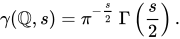
The local parameter 
,
so that the complete Riemann zeta function takes the form

This definition is only valid for 

the functional equation

Thus, the Riemann zeta function, initially defined only for

The (analytically extended) Riemann zeta function raises one of the most important questions in analytic number theory: the question of the exact location of its so-called non-trivial zeros. These lie in the “critical strip” 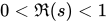

Dirichlet L-functions
The closest relatives of the Riemann zeta function are the Dirichlet L-functions, which include the Riemann zeta function as a special case. While in the Dirichlet series associated with the Riemann zeta function all 



is given, i.e., a group homomorphism from the group of elements that are invertible with respect to multiplication in the residue class ring 



follows from a Dirichlet character 


The trivial Dirichlet characters 


Now, if 

the Dirichlet series (also called the Dirichlet L-series)
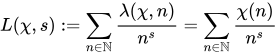
for

this also holds for the corresponding Euler product, and we have the identity

for
is the order of the Euler product. If we set 


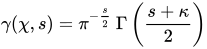
the gamma factor associated with 
.
The complete Dirichlet L-function thus has the form

A definition that holds only for 
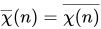
for all 

where the summation extends over all residue classes modulo the generator 


then the extended, complete Dirichlet L-function satisfies the functional equation

As required by the root number theorem, 
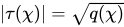
In 1837, the German mathematician Peter Gustav Dirichlet used the Dirichlet L-functions, named after him, to prove the Dirichlet's prime number theorem, according to which in every arithmetic sequence (also called an arithmetic progression)

where

Namely, that in every residue class 

Dedekind L-functions
The Riemann zeta function is defined on the field ![\textstyle \mathbb {Q} ({\sqrt[{3}]{2}})](https://wikimedia.org/api/rest_v1/media/math/render/svg/c3e5f15d9da5fba1cba6b046c80fa6dadcbdc86f)

![n_{K}=[K:\mathbb {Q} ]\in \mathbb {N}](https://wikimedia.org/api/rest_v1/media/math/render/svg/1644286516fc1fb7ec8de773b43c72e5326b82b3)



The Dedekind L-function (also known as the Dedekind zeta function) with respect to 

In the sum, 


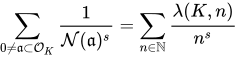
are thus

For every 


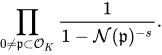
Here, the product extends over all prime ideals 

This form of the Euler product does not yet show the individual Euler factors


![d=[K:\mathbb {Q} ]=n_{K}=n_{1}+2n_{2}.](https://wikimedia.org/api/rest_v1/media/math/render/svg/2316c7890e43bce5b416f2d6c4e23e222156e3ea)
The local parameters 

- every ideal
has a “prime ideal decomposition” that is unique up to the order of the factors

in prime ideals 


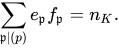
Using the knowledge of the inertia indices for every 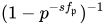

by factoring the polynomials 
![\mathbb {C} [X]](https://wikimedia.org/api/rest_v1/media/math/render/svg/b6c0e47242946827f33aad1803d66106d2f0307e)
The gamma factor with respect to

The value of the discriminant of
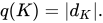
Thus, the complete L-function of

This function has an analytic continuation to the complex plane with simple poles at 


Dedekind L-functions always have a root of 1:

Thus, the analytically extended, complete L-function of

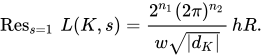
The analytically extended function 

This makes

03Conjectural information
One can list characteristics of known examples of L-functions that one would wish to see generalized:
- location of zeros and poles;
- functional equation, with respect to some vertical line Re(s) = constant;
- interesting values at integers related to quantities from algebraic K-theory.
Detailed work has produced a large body of plausible conjectures, for example about the exact type of functional equation that should apply. Since the Riemann zeta function connects through its values at positive even integers (and negative odd integers) to the Bernoulli numbers, one looks for an appropriate generalisation of that phenomenon. In that case results have been obtained for p-adic L-functions, which describe certain Galois modules.
The statistics of the zero distributions are of interest because of their connection to problems like the generalized Riemann hypothesis, distribution of prime numbers, etc. The connections with random matrix theory and quantum chaos are also of interest. The fractal structure of the distributions has been studied using rescaled range analysis. The self-similarity of the zero distribution is quite remarkable, and is characterized by a large fractal dimension of 1.9. This rather large fractal dimension is found over zeros covering at least fifteen orders of magnitude for the Riemann zeta function, and also for the zeros of other L-functions of different orders and conductors.

04Birch and Swinnerton-Dyer conjecture
One of the influential examples, both for the history of the more general L-functions and as a still-open research problem, is the conjecture developed by Bryan Birch and Peter Swinnerton-Dyer in the early part of the 1960s. It applies to an elliptic curve E, and the problem it attempts to solve is the prediction of the rank of the elliptic curve over the rational numbers (or another global field): i.e. the number of free generators of its group of rational points. Much previous work in the area began to be unified around a better knowledge of L-functions. This was something like a paradigm example of the nascent theory of L-functions.

05Rise of the general theory
This development preceded the Langlands program by a few years, and can be regarded as complementary to it: Langlands' work relates largely to Artin L-functions, which, like Hecke L-functions, were defined several decades earlier, and to L-functions attached to general automorphic representations.
Gradually it became clearer in what sense the construction of Hasse-Weil zeta functions might be made to work to provide valid L-functions, in the analytic sense: there should be some input from analysis, which meant automorphic analysis. The general case now unifies at a conceptual level a number of different research programs.
Sources and credits
This article is adapted from the Wikipedia article “L-function”, written by its contributors and licensed under CC BY-SA 4.0. Fathomly has changed the layout, removed citation markers, navigation and maintenance notices, and adjusted punctuation. This adapted version is shared under the same license. For references, see the original article.
Images, from Wikimedia Commons:
- Riemann-Zeta-Func.png by Empetrisor, CC BY-SA 4.0
- RiemannZetaXRay.png by Chrgue, CC BY-SA 4.0
- Peter Gustav Lejeune Dirichlet.jpg by Unknown authorUnknown author, Public domain
- DirichletLFunction mod7 ind2.png by Chrgue, CC BY-SA 4.0
- Dedekind.jpeg by not found, Public domain
Fathomly is not affiliated with or endorsed by the Wikimedia Foundation. Spotted a problem? Tell us.