Kondo model
Model for physics of semiconductors
The Kondo model (sometimes referred to as the s-d model) is a model for a single localized quantum impurity coupled to a large reservoir of delocalized and noninteracting electrons. The quantum impurity is represented by a spin-1/2 particle, and is coupled to a continuous band of noninteracting electrons by an antiferromagnetic exchange coupling 
01Kondo Hamiltonian
The Kondo Hamiltonian is given by
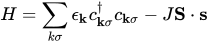
where 
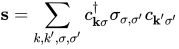
is the local spin-density of the noninteracting band at the impurity site (

02History
Jun Kondo applied third-order perturbation theory to the Kondo model and showed that the resistivity of the model diverges logarithmically as the temperature goes to zero. He explained why metal samples containing magnetic impurities have a resistance minimum (see Kondo effect). The problem of finding a solution to the Kondo model which did not contain this unphysical divergence became known as the Kondo problem.
A number of methods were used to attempt to solve the Kondo problem. Phillip W. Anderson devised a perturbative renormalization group method, known as poor man's scaling, which involves perturbatively eliminating excitations to the edges of the noninteracting band. This method indicated that, as temperature is decreased, the effective coupling between the spin and the band, 
The Kondo problem was finally solved when Kenneth G. Wilson applied the numerical renormalization group to the Kondo model and showed that the resistivity goes to a constant as temperature goes to zero.
The Kondo model is intimately related to the Anderson impurity model, as can be shown by Schrieffer-Wolff transformation.
03Variants
There are many variants of the Kondo model. For instance, the spin-1/2 can be replaced by a spin-1 or even a greater spin. The two-channel Kondo model is a variant of the Kondo model which has the spin-1/2 coupled to two independent noninteracting bands. All these models have been solved by Bethe ansatz. One can also consider the ferromagnetic Kondo model (i.e. the standard Kondo model with J > 0).
Sources and credits
This article is adapted from the Wikipedia article “Kondo model”, written by its contributors and licensed under CC BY-SA 4.0. Fathomly has changed the layout, removed citation markers, navigation and maintenance notices, and adjusted punctuation. This adapted version is shared under the same license. For references, see the original article.
Fathomly is not affiliated with or endorsed by the Wikimedia Foundation. Spotted a problem? Tell us.
