Kleisli category
Category theory
In category theory, a Kleisli category is a category naturally associated to any monad T. It is equivalent to the category of free T-algebras. The Kleisli category is one of two extremal solutions to the question: "Does every monad arise from an adjunction?" The other extremal solution is the Eilenberg-Moore category. Kleisli categories are named for the mathematician Heinrich Kleisli.
01Formal definition
Let ⟨T, η, μ⟩ be a monad over a category C. The Kleisli category of C is the category CT whose objects and morphisms are given by

That is, every morphism f: X → T Y in C (with codomain TY) can also be regarded as a morphism in CT (but with codomain Y). Composition of morphisms in CT is given by

where f: X → T Y and g: Y → T Z. The identity morphism is given by the monad unit η:
.
An alternative way of writing this, which clarifies the category in which each object lives, is used by MacLane. We use very slightly different notation for this presentation. Given the same monad and category 


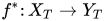


Then the identity morphism in
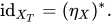
02Extension operators and Kleisli triples
Composition of Kleisli arrows can be expressed succinctly by means of the extension operator (-)# : Hom(X, TY) → Hom(TX, TY). Given a monad ⟨T, η, μ⟩ over a category C and a morphism f : X → TY let
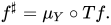
Composition in the Kleisli category CT can then be written

The extension operator satisfies the identities:

where f : X → TY and g : Y → TZ. It follows trivially from these properties that Kleisli composition is associative and that ηX is the identity.
In fact, to give a monad is to give a Kleisli triple ⟨T, η, (-)#⟩, i.e.
- A function
;
- For each object
in
;
- For each morphism
in

such that the above three equations for extension operators are satisfied.
03Kleisli adjunction
Kleisli categories were originally defined in order to show that every monad arises from an adjunction. That construction is as follows.
Let ⟨T, η, μ⟩ be a monad over a category C and let CT be the associated Kleisli category. Using Mac Lane's notation mentioned in the “Formal definition” section above, define a functor F: C → CT by


and a functor G : CT → C by


One can show that F and G are indeed functors and that F is left adjoint to G. The counit of the adjunction is given by

Finally, one can show that T = GF and μ = GεF so that ⟨T, η, μ⟩ is the monad associated to the adjunction ⟨F, G, η, ε⟩.
Showing that GF = T
For any object X in category C:
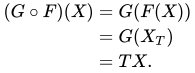
For any 
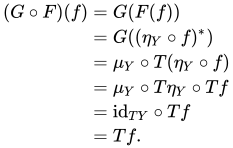
Since 


Sources and credits
This article is adapted from the Wikipedia article “Kleisli category”, written by its contributors and licensed under CC BY-SA 4.0. Fathomly has changed the layout, removed citation markers, navigation and maintenance notices, and adjusted punctuation. This adapted version is shared under the same license. For references, see the original article.
Fathomly is not affiliated with or endorsed by the Wikimedia Foundation. Spotted a problem? Tell us.